Are 12-Step Programs Required for Recovery?

Over 20 years of working with patients with substance use disorder, I am frequently asked:
“Are 12-step programs required for recovery?”
The simple answer is: No.
However, that answer deserves discussion and thought.
12-step programs such as Alcoholics Anonymous (AA) and Narcotics Anonymous (NA) have helped millions of people rebuild their lives. For many individuals, they are life-saving. But they are not universally effective, and they should not be treated as a mandatory requirement for recovery.
Recovery is NOT… one-size-fits-all.
This article explores:
· The history of 12-step programs
· Where they are beneficial
· Where individuals may experience difficulty
· The debate around abstinence and medication-assisted treatment (MAT)
· Why individualized treatment matters
A Brief History of 12-Step Programs
Alcoholics Anonymous was founded in 1935 by Bill Wilson and Dr. Bob Smith. The 12-step model was built around:
The disease model of addiction
Peer accountability
Spiritual surrender
Lifelong recovery identity
Narcotics Anonymous was founded in 1953 and adopted the same 12-step structure for drug addiction (now called Substance Use Disorders).
The longevity of these programs speaks to their impact. AA is now available in over 180 countries and has millions of members worldwide.
Research shows that participation in AA is associated with improved abstinence outcomes compared to no treatment (Kelly, Humphreys, & Ferri, 2020). Social reinforcement, peer modeling, and accountability clearly matter.
But society today looks very different than it did in 1935.

Neuroscience has evolved. Trauma research has expanded. Medication treatments now exist, such as that of Online Suboxone Treatment. Cultural and religious beliefs have diversified.
Yet the core 12-step framework has remained largely unchanged. This should show some concern for why these programs remain a grounding framework in the recovery treatment community as daily life and so much has evolved in almost a hundred years. Just looking at science and specifically behavioral health fields, they have great expansions and changes in this timeframe.
The Spiritual Component and Higher Power
One common concern involves the spiritual emphasis of the 12 steps.
Although AA and NA describe themselves as spiritual rather than religious, references to God and surrendering to a higher power are built into the steps.
For individuals whose religious beliefs align with this framework, this can be incredibly powerful. Surrender can:
Reduce ego-driven thinking
Increase humility
Provide hope
Strengthen moral structure
However, for others, particularly individuals with religious trauma, atheistic beliefs, or differing spiritual views, being told to relinquish control to a higher power can feel disempowering.
Modern therapeutic approaches such as:
Cognitive Behavioral Therapy (CBT)
Motivational Interviewing
Acceptance and Commitment Therapy (ACT)
Trauma-informed care
These focus on restoring agency and building internal locus of control.
For some individuals, emphasizing powerlessness may conflict with empowerment-based therapy models.
Both frameworks can work—but not universally.
The Disease Model of Addiction
12-step programs strongly emphasize addiction as a lifelong disease.
Neuroscience does support that substance use disorder involves changes in reward circuitry and impulse regulation (Volkow & Koob, 2015). However, longitudinal studies show that many individuals achieve remission and do not remain in chronic relapse patterns (Heyman, 2009; Dawson et al., 2005).
The modern DSM-5 uses the term “Substance Use Disorder,” recognizing severity levels and variability in outcomes. This change happened back in 2013 moving to the continuum-based diagnosis with varying levels and removing the categories of substance abuse and substance dependence.
This change shows a largely unified and updated medical view of addiction, with the 12 steps not updating to keep up with more current modern and accepted views and models on this topic.
For some people, identifying as an addict for life promotes vigilance and accountability.
For others, it reinforces an identity that keeps addiction at the forefront of daily thought—even decades later.
Recovery experiences vary widely.
The “White Bear” Effect and Triggering Through Constant Focus
Psychologist Daniel Wegner’s “white bear” experiment demonstrated that when individuals are instructed not to think about something, they paradoxically think about it more (Wegner et al., 1987).
This ironic process theory suggests that suppression increases cognitive activation. Therefore, if someone is to get past the daily reminders or more constant reminders of substance usage, they need to eventually get to a point where this is not reminded to them. Understand that this takes time, but again with the new continuum-based model and not following a disease model, this is seen to be possible for anyone suffering from substance use disorders.
Additionally, research in social psychology indicates that much of human behavior is influenced by automatic or subconscious processes (Bargh & Chartrand, 1999). This would relate to having the frequent reminders of substance usage keeping this active subconsciously and potentially affecting our daily behavior.
For some individuals, repeatedly discussing substance use experiences in meetings may:
Activate cravings
Reinforce substance-related imagery
Increase mental visibility
For others, sharing reduces shame and increases accountability.
Again, the impact is individualized.
Anonymity in Small Communities (PA & WV Considerations)

Anonymity is foundational to 12-step programs.
However, in smaller towns across Pennsylvania and West Virginia, meetings often occur in:
Churches
Community halls
Known public buildings
If a town knows that NA meets every Tuesday at 7 p.m., simply being seen there can compromise privacy. This removes the anonymous aspect, and some may sadly face stigmas by attending. Also, the worry of stigmas or public scrutiny may stop some from ever attending. This is the same for in-person treatment facilities, the same worry may stop some from attending treatment. The anonymous aspect is one of the many Advantages of Telehealth such as that offered here at Recover Clarity.
Online meetings have helped improve anonymity and access. Virtual formats allow individuals to attend without public visibility, the same concept as with telehealth treatment.
Medication-Assisted Treatment and the “Clean” Debate
A significant controversy involves medication-assisted treatment (MAT), also known as medication for opioid use disorder (MOUD).
Medications such as:
Buprenorphine (Suboxone)
Methadone
Extended-release Naltrexone
are FDA-approved and evidence-based. Even though these are FDA-approved medications, there are great differences, such as those of Methadone vs. Suboxone.
Research shows MOUD:
Reduces mortality risk by over 50% (Sordo et al., 2017)
Improves retention in treatment
Reduces illicit opioid use
Decreases criminal justice involvement
However, in some 12-step circles, individuals taking these medications are told they are not “clean.”
This stigma can:
Discourage life-saving treatment
Increase shame
Reduce support engagement
The American Society of Addiction Medicine (ASAM) and the Substance Abuse and Mental Health Service Administration (SAMHSA) strongly endorse medication treatment as standard of care.
If someone is prescribed Suboxone, attending therapy, stabilizing employment, and rebuilding relationships, that is recovery. This is where the “clean” aspect view of many 12-step programs can cause harm is stopping someone from evidence-based medical treatment.
Excluding individuals because of medically supervised treatment contradicts current evidence-based practice.
Mandated 12-Step Attendance in Treatment Centers
Many treatment programs require 12-step participation. While peer support is valuable, mandating a specific model raises concerns. Also, this shows that the treatment facility may be running off greatly old and antiquated information and not more current evidence-based models of treatment and medicine.
Addiction treatment should be individualized. Consider variability in:
Trauma histories
Religious beliefs
Cognitive patterns
Mental health diagnoses
Trigger profiles
Forcing a patient into a framework they find triggering may increase relapse risk rather than reduce it.
Court-mandated 12-step attendance has shown mixed outcomes in research (Kelly et al., 2008). Motivation plays a significant role in effectiveness.
Treatment should offer options, not impose ideology.
The Complete Abstinence Model vs. Harm Reduction
12-step doctrine promotes complete abstinence from all mood-altering substances.
For many individuals, total abstinence provides:
Cognitive clarity
Emotional stability
Reduced relapse risk
However, harm reduction models acknowledge that rigid all-or-nothing frameworks can sometimes increase relapse severity. If someone believes they have “failed,” the psychological shift toward full relapse may accelerate.
Harm reduction does not encourage drug use. It recognizes that recovery paths differ.
For example, some individuals in Pennsylvania and West Virginia legally use medical marijuana for qualifying conditions. Whether this supports or undermines recovery depends on:
The individual’s substance history
Psychiatric profile
Pattern of use
Clinical oversight
Overconfidence (“I can just use a little”) is a well-documented relapse trigger. This is particularly true when involving a former primary drug of choice. This trigger is specifically discussed in the blog on Addiction Triggers: Identifying and How to Avoid Them.
Clinical judgment and individualized planning are essential.
What Research Says About 12-Step Effectiveness
A 2020 Cochrane review found that AA and 12-step facilitation interventions were at least as effective, and sometimes more effective, than other treatments for increasing abstinence rates (Kelly et al., 2020). Do note that this is not specifically looking at Opioid Use Disorder, which research still shows highest success rates with paired with MOUD or MAT treatment.
However:
Dropout rates are significant
Not all individuals engage
Some report negative experiences
Studies suggest that approximately 5–10% of AA attendees maintain long-term continuous participation (Fiorentine, 1999), though measurement is difficult due to anonymity.
The takeaway is this: 12-step programs work very well for some, but they do not work for everyone.
Recovery Is Individual
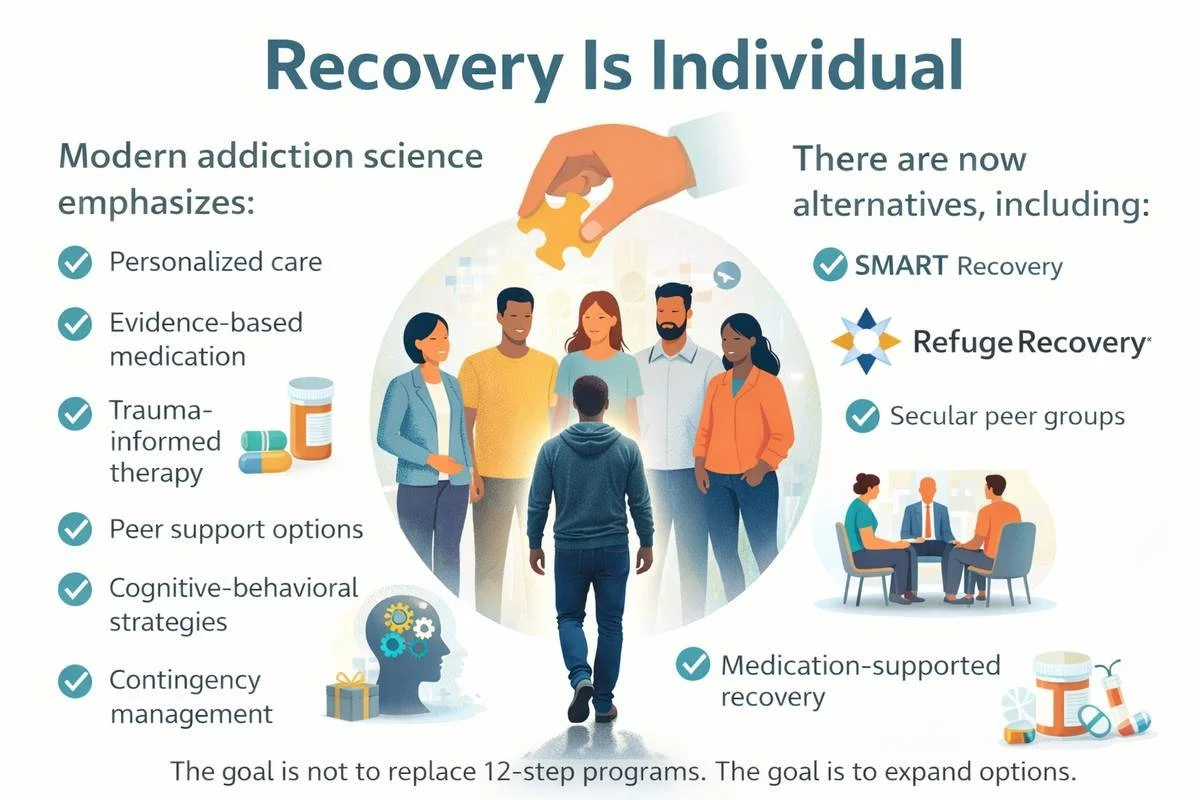
Modern addiction science emphasizes:
Personalized care
Evidence-based medication
Trauma-informed therapy
Peer support options
Cognitive-behavioral strategies
Contingency management
There are now alternatives, including:
SMART Recovery
Refuge Recovery
Secular peer groups
Medication-supported recovery
The goal is not to replace 12-step programs. The goal is to expand options.
Final Thoughts
12-step programs are not required for recovery. They are one pathway among many.
For some individuals, AA or NA is transformative. For others, different approaches provide better alignment with beliefs, psychology, and medical needs.
The recovery industry must move beyond a one-size-fits-all mentality.
True recovery support means:
Offering options
Respecting evidence
Reducing stigma
Individualizing treatment
The goal is not forcing someone into a model.
The goal is helping them build a life they no longer need to escape from.
References
Bargh, J. A., & Chartrand, T. L. (1999). The unbearable automaticity of being. American Psychologist, 54(7), 462–479.
Dawson, D. A., et al. (2005). Recovery from DSM-IV alcohol dependence. Addiction, 100(3), 281–292.
Heyman, G. M. (2009). Addiction: A disorder of choice. Harvard University Press.
Kelly, J. F., Humphreys, K., & Ferri, M. (2020). Alcoholics Anonymous and other 12-step programs for alcohol use disorder. Cochrane Database of Systematic Reviews.
Sordo, L., et al. (2017). Mortality risk during and after opioid substitution treatment. BMJ, 357, j1550.
Volkow, N. D., & Koob, G. F. (2015). Brain disease model of addiction. The Lancet Psychiatry, 2(8), 677–679.
Wegner, D. M., et al. (1987). Paradoxical effects of thought suppression. Journal of Personality and Social Psychology, 53(1), 5–13.