How To Guide for Guided Imagery

If you are new to this blog, it is advised to go back and read the past two blog posts on Recover Clarity’s Blog Page as they go over the history of guided imagery as well as how this practice can relate to addiction treatment. Guided imagery in general is a great relaxation technique which can help overall in life and has been clinically proven to help in addiction treatment (Kominars, 1997; Lowry et al., 2021).
As this guide is geared towards helping those in addiction treatment, please note this is a useful tool in a recovery journey. Often that treatment needs to be paired with other forms of treatment, especially therapy, and at times other medications. For instance, 7-OH Addiction often will need paired with treatment such as Suboxone or another medication.
If you are desiring assistance with learning Guided Imagery or other holistic practices, contact us to schedule a session. We can help you either advance your practice or get your practice started.
Brief Historical Overview
Guided imagery is not a new practice and was first being used in Western Medicine dating back to the 1940s with growing use going through the 1980s. Since then, it has become widely used in Western Medicine as a holistic practice for relaxation spanning many areas of medicine (National Center for Contemporary and Integrative Health, 2021).
But to show the usefulness of this practice, it stems from other practices such as Buddhism and Hinduism for thousands of years. As it is not exactly the same as what guided imagery is in Western Medicine, there are great similarities. These practices have been used to assist in achieving enlightenment and for their calming properties of both the body and the mind.
Basic Principles of Guided Imagery
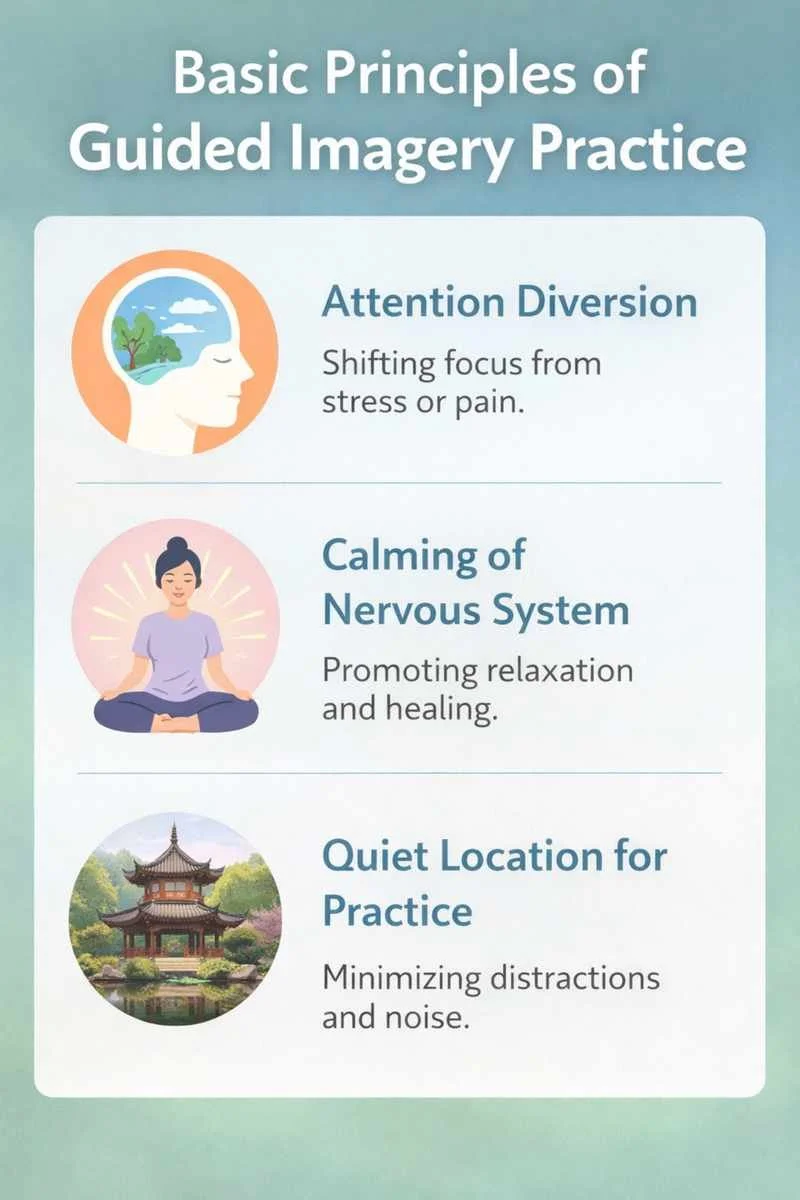
There are some basic principles to understand the purpose of this practice. This way you are aware of what the purpose of this practice is as well as what to notice if the type of practice is working for you. There are different variations of guided imagery, some with different purposes, and some or all may work to help you in life and with addiction recovery.
Attention Diversion
When looking at one of the best parts of guided imagery is the ability to divert attention away from things that can be triggering and causing triggers. Attention is a limited cognitive resource, what this means is that we only have so much attention we can use at one time. Understanding this and using guided imagery, we can immerse ourselves in something pleasant pulling any attention away from something that is triggering or a craving to use a substance.
The use of guided imagery will give us a break from the negative thought and break any cycle of negative thought patterns during this practice. Note that this does not eliminate the trigger or craving but can greatly diminish the strength of this giving us a mental break and grounding us.
Calming of the Nervous System

Using this relaxation technique activates the parasympathetic part of the autonomic nervous system. This is explained more in detail in the first installment of this blog series on the Intro to Guided Imagery Blog. In short, the concept is simple, when we are stressed the sympathetic part of this nervous system is activated, the fight-or-flight response, and using this practice we activate the other part which is used to calm us down. Essentially using holistic and mental practice to change a physiological response inside the body.
Where to Practice Guided Imagery
This can be different for everyone and with time being able to practice this in more distracting environments is completely feasible. Ideally to start, you want a quiet location free from distractions and interruptions. This can be anywhere that is comfortable for or at least initially free from distractions, such as your car if at work, a basement if at home, or out in a park. Sometimes people find having a place that has dimmer light can be of benefit or using something like a sleeping mask to help if in a bright area, but this is not required, just preferred by some. Overall, it is whatever works best for you.
Preparing the Body for Your Practice
Guided imagery starts with preparing your body for practice, before visualizing the imagery or scene starts. This preparation does not take long but is crucial as we are telling our body that we are going to take control of our autonomic nervous system and calm the body and mind. This step is essential for the practice to be successful and get the full benefit of this relaxation technique.
Setting and Timing
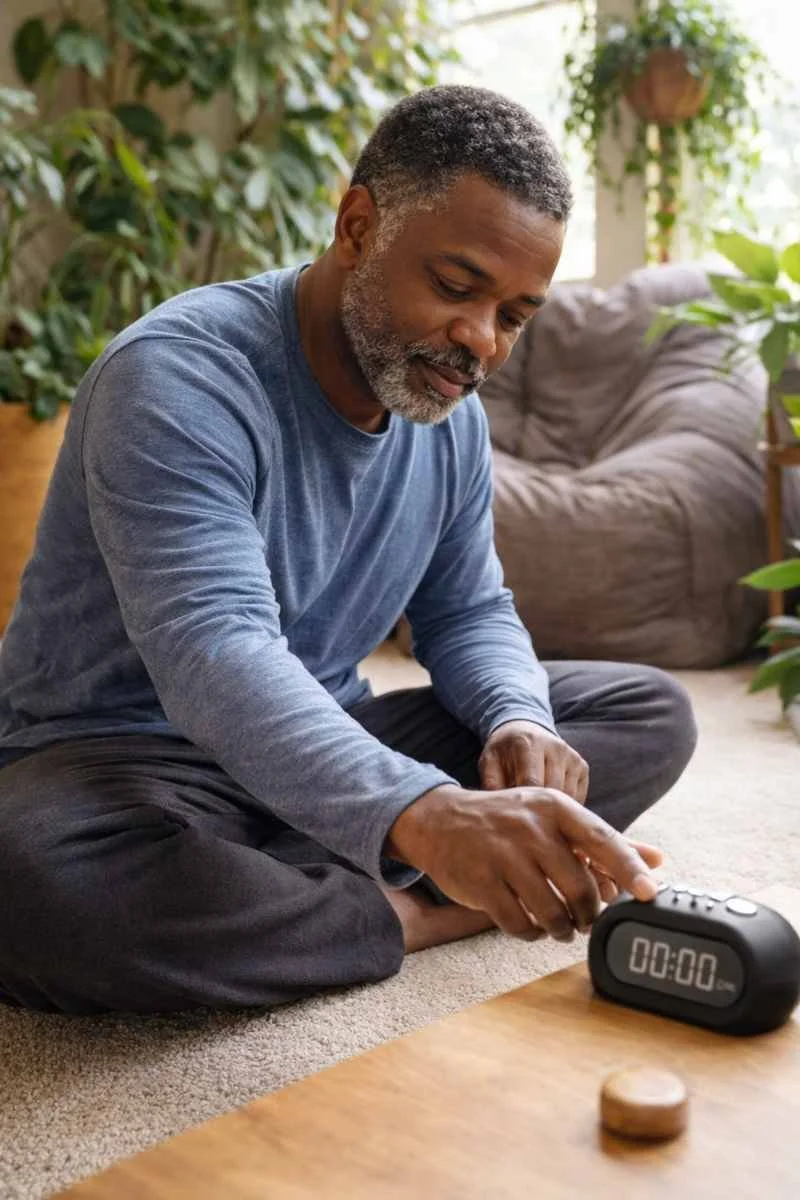
As previously mentioned, make sure you have a relaxing environment to start your practice. In this environment start by sitting or lying down in a comfortable manner. Next choose your time limit, often 5-15 minutes is ample amount of time for the practice. Set a timer to help assist you with knowing when the time you have available has passed. Sometimes this practice can result in a person falling asleep, even though it is not common, the relaxation can be that much. Therefore, a timer will ensure you wake up in the event this happens. If this does happen, over time you will not fall asleep and will stay mentally active during your practice.
Control Your Breathing
Now it is time to start to relax with some controlled breathing and releasing tension in the body. Start by slowing your breathing with controlled breaths in a pattern. Inhaling to the count of 4 and even more slowly exhaling to the count of 6 is common but do what works best and feels natural to you. This should be more natural and does not have to be exact timing, you will find a comfortable pattern and get used to it. If too much attention is focused on the timing of the breaths, it will defeat part of the purpose of this relaxation part.
Slowing your breathing is one of the things we can control about our autonomic nervous system, allowing us to use this great tool to assist in calming ourselves. This is actual about the only thing we truly have control over our autonomic nervous system, besides eventually using this practice to activate the parasympathetic nervous system. Continue the controlled breathing for one to two minutes, in combination with the next steps.
Relaxing The Body
Next pay attention to your body and work on relaxing. Focus on your jaw and make sure you unclench it and let it relax. Sometimes by pressing more pressure on the jaw, biting down hard, then relaxing slowly will assist with this. This is similar to the relaxation process of progressive muscle relaxation practices.
Allow your shoulders to drop and release any tension there. This again is done with the controlled breathing previously discussed and for only one to two minutes but keeping them in a relaxed state during this practice.
Now that you are in a comfortable environment and more relaxed you are ready to start your guided imagery practice. This is the time you will start to set the image using your sensory prompts.
Sensory Prompts
With guided imagery you want to use all your available senses. But not in the common way you may be thinking of, you are using these mentally to bring them to your full attention. Remember the great focus of this practice is on how this can take up all available attention and using our senses is the way this is achieved. One sense that is not as commonly used is that of taste, but the others of sight, hearing, smell, and touch are to be used. Taste can be used in some scenarios if it is applicable.
In building the mental scene that you have chosen based on the variation of guided imagery you are going to use, will guide how this practice starts for you. For this example, I am going to use a day at the beach.

Sight
Start with building the imagery visually, seeing the ocean, a few clouds, the warm sand, waves crashing. Take some time and look around in this mental image and build a good solid view of your surroundings. Details do not need to be perfect at this point as you will add to this after we add in other sensory information.
Sound
Take a second and focus on the waves you are seeing, allow yourself to hear the sound of the crashing with each wave coming in. Continue to think of this sound as you continue to build your scene. Even when looking at other areas of the beach, never let the faint sound of the waves crashing leave your senses. This is the same as if you were physically there, even if you focus on other aspects of the beach, you would still be hearing the waves.
Touch
Now allow yourself to feel the warmth of the sun on your skin, activating the sense of touch. Look at the sky, see the sun, feel that warmth around you that is in the air. Remember to still hear the waves in the background. Feel the sand between your toes, which is soft but also a little gritty, and warm to the touch. You may also feel a slight breeze on your skin, which may be easier to bring into attention as often there is slight air movement around us at all times (even if we do not notice it).
Smell
With your next breath in through your nose, notice the smell of the ocean and the sea salt. You also notice the light scent of coconut coming from sunscreen. This can be added into practice first by using a diffuser or candle with similar scents to the beach.
Bodily Cues and Detail
Now that you have your scene built, take time to relax with these amazingly calm sensory perceptions of the warmth of the sun, smells and sound of the ocean, if possible, taste the saltiness of the air. Stay in this moment and continue to pay attention to your bodily cues. Your hear rate is slowing, muscles relaxing, as you would be in that state during your chosen memory for this visualization practice.
Now that you are in the memory, try to focus on as much detail as possible, allowing all these four (possibly five) senses to be in sync at one time. With this detail, try to remember what you were wearing, what other people are wearing, how many clouds are in the sky. Hyperfocus on these details, taking up all your available attention.
Types of Guided Imagery
There are multiple ways in which guided imagery can be used and practiced. And practice is a key word here, this is not a single time use, it is something to be used frequently and will get stronger over time. Also, as someone learns guided imagery, they may use a few forms of it or even make personal adjustments as they see fit. There isn’t a 100% correct or incorrect way to complete guided imagery, as long as it provides the relaxation that the person needs.
As there are different types of guided imagery, some may have better applications depending on your needs, but all are great tools to have a calmer, more relaxed life. This blog focuses on addiction treatment and some of the applications of this practice for that purpose. But these practices can help in many other areas of life or just to live a calmer more stress-free life in general.

Deep Visualization from Memory (Self-Place Imagery)
This is one that I most commonly recommend for patients to try. This is because it draws from a past experience and assists in decreasing having to create a new memory which can be harder for many at first. This is greatly useful in taking attention away from stressors, triggers, and assist in craving control.
The concept here is equally about activating the parasympathetic nervous system to provide a calming effect as well as focusing all attention on something positive.
In this practice, it is extremely important to find a memory that has no trauma or distress involved in it, remember this was discussed a potential problem with the practice in the blog about How Guided Imagery Helps Addiction. Make sure nothing else bad happened that day or people in the memory that can be a stressor for you. Often these come from memories alone or from our childhood. These memories are often best to be outdoors as that offers more sensory cues, such as weather, smell of the area, and wind.
Performance and Confidence Imagery
This practice is focused on assisting with seeing the positives of a future version of oneself. Often in early recovery it can be hard to see a positive future, rebuilt relationships from a period of active addiction, or other positive changes in life. Even thinking of the damage that may have come from active addiction can be stressful and even overwhelming. This type of practice of guided imagery can help with these as well as assist in building motivation.
Confidence Imagery for Motivation
This practice can assist with motivation for a journey of recovery. Motivation is a huge factor in life for many reasons with anything that we want to change in life. Recovery is no different.
With this type of guided imagery, you want to sit and think of what a better life would be. This could be spending quality time with family, having money for a vacation, getting a promotion at work, it can literally be anything you desire.
With this you want to build the scene of this situation and practice using the sensory prompts mentioned earlier. With this you see this better life helping you see how things can be if you continue your journey of recovery, therefore providing motivation for this positive change in your life to lead to other positives in the future.

Using Guided Audio Instruction
Some people who struggle with starting their own guided imagery practice may use assistance from guided audio instructions which can easily be found on YouTube, Spotify, or other streaming services. These are more “generic” forms but can be a good starting point to help someone get used to the practice itself. With these you will be guided to what to focus on, but by creating a fake environment and not drawing from direct memory.
For this practice you still need to start by doing the controlled breathing and relaxing your shoulders, jaw, and body. This is important with all these practices to get the body ready for this relaxation technique.
Difficulties with Guided Audio
One difficulty with some guided audio is if you have not experienced what the person is telling you, it is harder to bring the senses into focus. Such as for someone that has never been to the beach, they have no internal memory of the smell of saltwater, the same goes for someone that has never been around pine trees. If you decide to use this method, try to find an audio guide that sets a setting you can truly align with from past experiences.
Another difficulty in this audio-based practice is that you are paying a great deal of attention to what is being said in the recording. This then does not allow you to build the sense of sound in your practice, but this still does help with attention diversion. This type of practice also has a person paying more attention to what is being said than the scene itself and can produce fewer relaxing effects.
With these more generic situations, you must be mindful that you have no triggering or traumatic memories associated with them, as this can heighten your sympathetic nervous system, only making you more tense and doing the opposite of what the practice is meant to accomplish.
Body-Based Calming Practice
This one may be less useful overall specifically for assisting in addiction recovery, especially with triggers and craving, but is still a relaxing and calming practice. This is more just focused on imagining physical sensations such as warmth, softening tension, heaviness or some other physical sensation. This often is paired with a breathing exercise, not just in the beginning, but during the entire duration of the practice.
Why this may not be best for addiction treatment is that it does not take all the full attention you have available. Which is what is useful to assist in negating those thoughts we are trying to take the mind away from. However, this can assist in decreasing overall stress, which is a benefit overall, and often stress is a guiding trigger in addiction.
Music Based Guided Imagery
In a future blog post, I will write about a variation of guided imagery that I use daily. This is a great stress reducer but can be done while driving or other tasks such as chores. As mentioned, this practice is to be yours and can be modified to whatever works best for you. A problem for some is needing some relaxation but at times we cannot close ourselves away from the world for five to fifteen minutes. Subscribe to this blog to get updates for when this and other useful blogs are posted. To do this go to the bottom of this page on the right side and type in your email address and Sign Up to receive email updates.
Final Notes on Assistance with Addiction Treatment
As guided imagery is a great tool to assist in addiction treatment, it is not the only tool. Often other assistance is needed such as that with Online Addiction Therapy, Group Therapies, and/or Support Groups.
Medications for Opioid Use Disorder (MOUD) or Medication Assisted Treatment (MAT) also may be needed for those suffering from Opioid addiction to Kratom Addiction or 7-OH Addiction to assist with the physical and psychological withdrawal and cravings. Usage of medications can be greatly beneficial, such as that of Suboxone or Sublocade. When paired with therapy and holistic practices such as guided imagery greatly increase the success rates of addiction recovery.
References
Kominars, K. D. (1997). A study of visualization and addiction treatment. Journal of Substance Abuse Treatment.
Lowry, N., Marsden, J., Clydesdale, B., Eastwood, B., Havelka, E. M., & Goetz, C. (2021). Acute impact of self-guided mental imagery on craving in cocaine use disorder. Addiction.
National Center for Complementary and Integrative Health. (2021, June 8). Relaxation techniques: What you need to know. U.S. Department of Health and Human Services, National Institutes of Health. https://www.nccih.nih.gov/health/relaxation-techniques-what-you-need-to-know