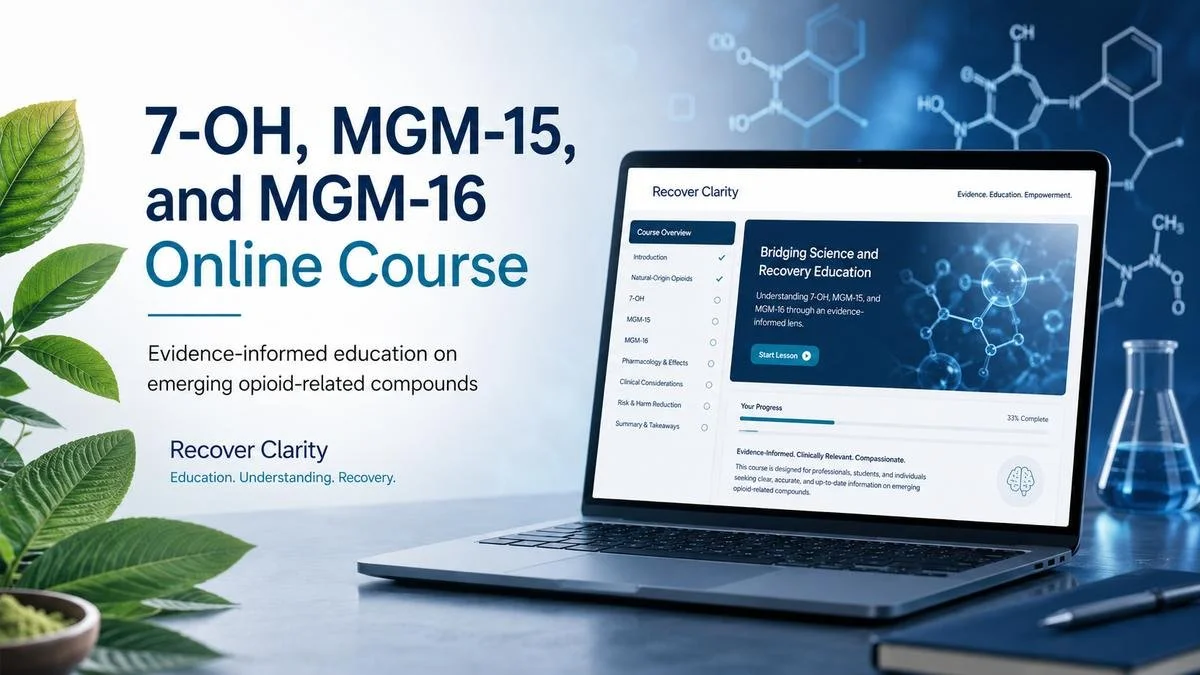
7-OH, MGM-15, and MGM-16 Online Course
Understanding the Products, Dependence, Treatment, and Recovery
Products containing concentrated 7-OH and newer compounds such as MGM-15 and MGM-16 have emerged faster than accurate public education about them.
They may be sold in gas stations, vape shops, convenience stores, specialty retailers, or online. Their appearance, packaging, and association with kratom can create the impression that they are simply stronger versions of a familiar botanical and natural product.
That description may fail to communicate how significantly these products can differ from traditional kratom leaf, or how rapidly tolerance, opioid-like physical dependence, withdrawal, and compulsive use can develop.
The 7-OH, MGM-15, and MGM-16: Understanding the Products, Dependence, Treatment, and Recovery course provides a structured, self-paced introduction to this changing issue.
It was developed for individuals concerned about their own use, loved ones trying to understand what someone may be experiencing, and professionals encountering these products through behavioral health, medicine, emergency response, education, or community work.
The course does more than describe the substances. It helps learners understand how a pattern of use can progress, recognize signs of increasing severity, compare possible treatment pathways, evaluate the limitations of self-directed reduction, and begin building a more sustainable recovery plan.
Course format: Self-paced online education
Course length: 90 -120 minutes
Chapters: Seven
Included: Worksheets, practical exercises, lesson references, and recovery-planning tools
Course price: Introductory price of $39
Why This Course Is Needed
Many people who developed problems with 7-OH, MGM-15, or related products most commonly did not intentionally seek out an unfamiliar illicit opioid.
They may have purchased a colorful bottle near an energy-shot display, tried a tablet offered as an enhanced kratom product, or ordered something online that was described as botanical, natural, safe, and for everyone.
Some began using the product for energy, pain, anxiety, sleep, mood, reduce discomfort from another substance, or as an alcohol replacement. An effect that initially seemed helpful may have gradually become something the person needed to repeat more frequently.
Over time, the person may notice that the original amount no longer works as well. Doses become larger and/or more frequent. Morning or overnight dosing begins. The product is used less to create the desired effect and more to avoid feeling sick, anxious, restless, depressed, or unable to function.
At that point, the person and family may struggle to find reliable guidance.
Questions commonly include:
What is actually in the product?
Is concentrated 7-OH the same as traditional kratom?
What are MGM-15 and MGM-16?
Is this an opioid problem?
Does physical dependence mean that someone has an addiction (substance use disorder)?
What might withdrawal involve?
Is stopping at home safe?
Should the person gradually reduce the original product?
When is medical evaluation appropriate?
Can buprenorphine (Suboxone) or another medication be considered?
What happens after the substance is stopped?
This course was designed to organize those questions into a logical educational process.
It does not assume that one treatment is right for everyone as there is no one size fits all treatment. It gives learners enough background to understand the concern, identify important risks, prepare for professional evaluation, and make better-informed decisions.

What You Will Learn
By completing the course, learners will be better prepared to:
Distinguish traditional botanical kratom from modern extracts and concentrated products
Explain the differences between mitragynine (Kratom), 7-OH, MGM-15, and MGM-16
Recognize how packaging, product labels, and retail availability can create misleading assumptions
Understand opioid-receptor activity in plain language
Explain how relief, reward, tolerance, and positive/negative reinforcement can contribute to repeated use
Distinguish tolerance, physical dependence, withdrawal, and substance use disorder
Identify patterns that may indicate increasing severity
Organize information needed for a medical or behavioral-health evaluation
Compare withdrawal management, supported reduction, medications, counseling, and other forms of care
Understand the potential roles and limitations of buprenorphine, methadone, and naltrexone
Evaluate what self-directed reduction can and cannot realistically accomplish
Identify situations in which a reduction attempt should stop, and professional help should be obtained
Plan for cravings, triggers, sleep disruption, relationship strain, financial consequences, and return-to-use risk
Build a practical short-term recovery action plan
The course provides education rather than an individualized diagnosis or treatment recommendation.
View other educational courses by visiting Recovery Clarity’s Education Hub page.
Course Outline
Chapter 1: What Are Kratom, 7-OH, MGM-15, and MGM-16?
The course begins by establishing a clear vocabulary.
Learners examine traditional botanical kratom, mitragynine extracts, concentrated 7-OH products, MGM-15, MGM-16, and other related compounds.
This chapter explains why true pure leaf kratom should not automatically be treated as equivalent to a concentrated tablet, liquid shot, gummy, or semi-synthetic or fully synthetic modified product.
It also explores how manufacturing, extraction, oxidation, product labeling, packaging, and retail placement can influence what a consumer believes they are purchasing.
The chapter does not suggest that botanical kratom is risk-free. Instead, it explains why the broad word “kratom” may conceal meaningful differences among modern products.
Topics include:
Traditional kratom use
Mitragynine and its role in botanical kratom
Extracts and concentrated products
What 7-OH is
How commercial concentrated 7-OH differs from trace amounts in leaf
What MGM-15 and MGM-16 are
Product-label limitations
Why legal or retail availability can be misinterpreted as proof of safety
Changing federal and state regulatory concerns
Chapter 2: Why These Products Can Become Dangerous
The second chapter examines the risks that can emerge as products become more concentrated, potent, fast-acting, or unpredictable.
The experience created by a substance is affected by more than the product name. Amount, frequency, tolerance, individual metabolism, product composition, and other substances can all influence risk.
Learners examine how repeated dosing, uncertain labeling, product variability, sedative combinations, and escalating use may increase the potential for serious harm.
The chapter also distinguishes general warning signs from symptoms that require immediate emergency assistance.
Topics include:
* Product composition and uncertainty
* Increasing concentration and potency
* Rapid onset and repeated dosing
* Combining products with alcohol, benzodiazepines, opioids, or other sedatives
* Reduced awareness of the amount consumed
* Overdose concerns
* Emergency warning signs
* Why previous experience with a product does not guarantee that a new package or batch will produce the same effect
Chapter 3: How Dependence and Addiction Develop
Dependence does not always begin with a desire to become intoxicated.
A person may initially use a substance because it appears to provide pain reduction, energy, calming effect, emotional relief, sleep, improved mood, or temporary escape from withdrawal.
When the experience adds something desirable, positive reinforcement may encourage repeated use. When the substance removes pain, anxiety, withdrawal, fatigue, or emotional discomfort, negative reinforcement may become even more powerful.
The course explains these psychological and biological processes in understandable language.
Topics include:
What mu-opioid receptors normally do
Opioid agonist activity
Relief, reward, pain reduction, and emotional reinforcement
Positive and negative reinforcement
Tolerance
Biological adaptation
Physical dependence
Psychological reliance
Cravings and learned cues
Loss of control
The difference between dependence and substance use disorder
This chapter helps learners understand why telling someone to “just stop” may fail to address the processes maintaining the pattern.
Chapter 4: Recognizing Dependence, Withdrawal, and Severity
People may delay seeking assistance because they are uncertain whether their experience is serious enough to justify treatment.
This chapter helps learners evaluate changes in the pattern of use without attempting to diagnose themselves or another person.
Possible warning signs include increasing amounts, dosing more frequently, waking during the night to use/dose, taking the product immediately in the morning, using primarily to avoid withdrawal, hiding purchases, experiencing financial consequences, and repeatedly failing to follow a reduction plan.
Learners are guided through organizing the information a clinician may need.
Topics include:
Frequency and duration of use
Estimated amount consumed
Timing of the first and last daily dose
Overnight or early-morning dosing
Withdrawal symptoms
Previous reduction attempts
Prior opioid exposure
Other medications and substances
Medical and psychiatric concerns
Chronic pain
Support availability
Work and caregiving responsibilities
Circumstances that may require urgent or higher-level care
This chapter includes a practical worksheet that can help the learner prepare for a professional evaluation.
Chapter 5: Understanding the Treatment Options
Treatment is a spectrum rather than one medication, program, or recovery philosophy.
An appropriate plan should consider the products involved, estimated exposure, frequency, duration, withdrawal pattern, previous attempts, medical and psychiatric history, pain, other substance use, environment, available support, responsibilities, and personal goals.
The course describes major treatment pathways without presenting one approach as universally correct. Again there is no one size fits all treatment and there are many levels of treatment care.
Topics include:
Outpatient medical evaluation
Supported reduction of the original product
Symptom-focused withdrawal management
Medical detoxification
Residential treatment
Outpatient behavioral-health treatment
Peer and community support
Buprenorphine medications
Methadone
Naltrexone
Matching treatment intensity to the individual
The difference between completing withdrawal and treating a continuing substance use disorder
Recover Clarity specializes in sublingual buprenorphine treatment (Online Suboxone Treatment), so buprenorphine receives additional discussion. That clinical emphasis is disclosed openly.
The course does not suggest that buprenorphine is appropriate for every learner or that it is the only legitimate treatment pathway.
Chapter 6: Self-Directed Reduction With Support
Many people begin searching for information because they want to stop without entering a formal addiction treatment program.
This chapter addresses self-directed reduction honestly, including both its potential role and its limitations.
Some individuals may be able to reduce the original product with professional consultation, consistent measurement, dependable support, and a stable environment. Other people may repeatedly exceed planned limits, experience significant withdrawal, substitute other substances, or return to their previous amount.
There is no single validated taper schedule that can be safely applied to every 7-OH, MGM-15, or MGM-16 user.
Topics include:
Whether the product can be measured consistently
Whether the person can maintain predetermined limits
Product variability
Preparing the environment
Identifying a support person
Tracking doses and symptoms
Avoiding unmonitored sedative substitution
Recognizing when the plan is no longer working
Establishing clear reasons to seek medical assistance
Moving to professional treatment without interpreting that decision as failure
The chapter provides educational planning tools but does not prescribe an individualized taper.
Chapter 7: Building Recovery After the Substance Is Reduced or Stopped
Stopping 7-OH, MGM-15, MGM-16 or mitragynine concentrates or stabilizing through medication is an important achievement, but it may be the beginning of a new recovery phase rather than the end.
The person may still face disrupted sleep, conditioned cues, cravings, financial stress, relationship damage, chronic pain, anxiety, depression, boredom, and the circumstances that initially contributed to use.
This chapter helps the learner move from immediate stabilization toward a more sustainable recovery plan.
Topics include:
Cravings and environmental triggers
Purchasing locations and familiar routes
Online product promotion and triggering content
Restoring sleep and daily structure
Building dependable support
Counseling and behavioral treatment
Creating a written return-to-use plan
Reduced tolerance and overdose risk
Repairing financial consequences
Rebuilding trust through consistent action
Addressing chronic pain or the original reason for use
Distinguishing a brief lapse from a sustained return to problematic use
Creating a practical seven-day recovery plan
Recovery is presented as a process built through repeated actions rather than one dramatic decision.
A setback is treated as information about what the recovery plan may still need, not as proof that the person is incapable of change.
What Is Included?
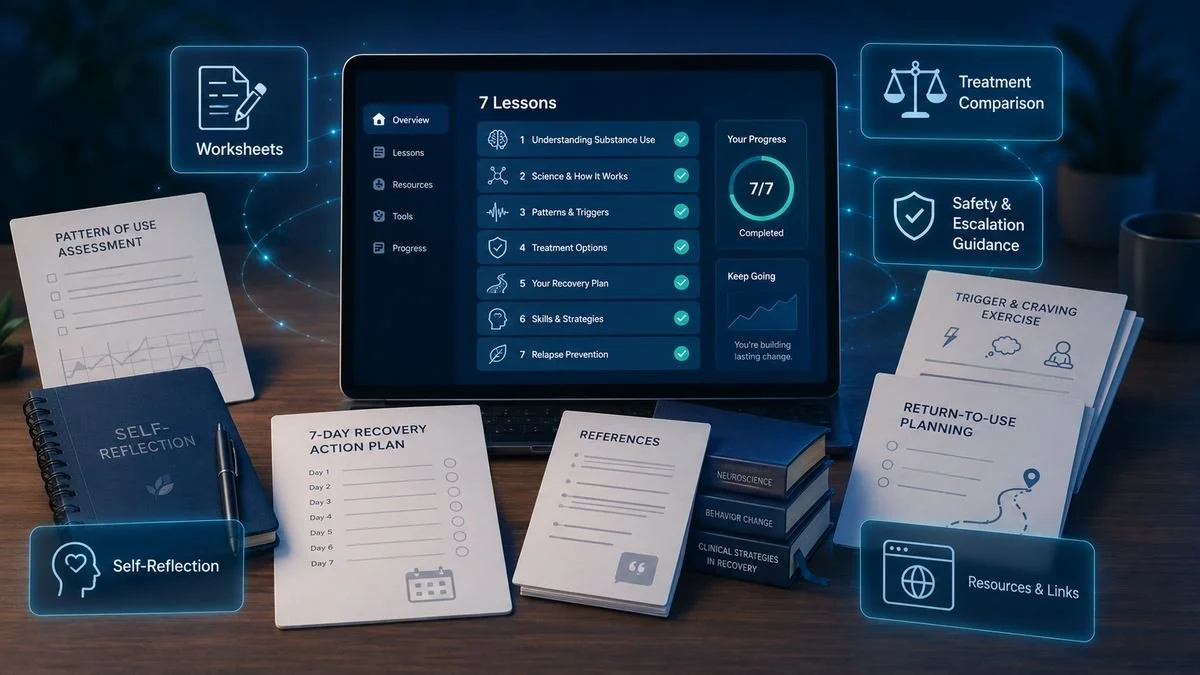
The course is organized as a guided learning experience rather than one long article or collection of unrelated warnings.
Enrollment includes:
Seven comprehensive chapters
Short online-course pages
Plain-language explanations
Lesson learning objectives
Guided self-reflection
Practical worksheets
A pattern-of-use assessment worksheet
Treatment-comparison education
Self-directed reduction planning considerations
Safety and escalation guidance
Trigger and craving exercises
A return-to-use planning exercise
A seven-day recovery action plan
Selected references at the end of each chapter
Links to additional Recover Clarity educational resources
The short-page format allows learners to pause, reflect, and return without having to navigate one continuous document.
Who Should Take This Course?
Individuals Using 7-OH, MGM-15, or Related Products
The course can help individuals understand what they may be taking, recognize changes in their pattern of use, identify physical dependence, organize information for an evaluation, and compare possible next steps for addressing 7-OH and MGM-15 Addiction.
Behavioral-Health Professionals
Counselors, therapists, social workers, case managers, peer recovery specialists, and treatment staff may benefit from structured foundational education about products that remain unfamiliar to many established treatment systems.
Parents, Partners, and Other Loved Ones
Loved ones may use the course to better understand why stopping can be difficult, how withdrawal and reinforcement contribute to continued use, what treatment options exist, and how recovery continues after the substance is removed.
Medical and Emergency Professionals
Physicians, nurses, first responders, emergency personnel, and other healthcare professionals may use the course as an introduction to concentrated 7-OH and related emerging compounds such as MGM-15 and MGM-16.
Educators and Community Organizations
Prevention professionals, college instructors, students, public-health workers, employers, advocacy groups, and community organizations may use the course to improve their understanding of this developing substance use concern.
No advanced medical or pharmacology background is required.
Course Leadership and Development
Developed by Ben Culler
Ben Culler has more than 20 years of experience working with people affected by substance use disorders.
His background includes graduate degrees in psychology, professional experience addressing substance use disorders within forensic and behavioral-health settings, and previous experience as a professor of psychology.
This combination contributes to a course that brings together direct substance use disorder experience, psychological theory, behavioral science, and higher-education course development.
The material is structured to help learners progress from foundational vocabulary to dependence, severity, treatment decisions, and practical recovery planning.
Informed by Multiple Perspectives
The course was developed with input from physicians, therapists, behavioral-health professionals, and individuals who have personally experienced substance use treatment and recovery.
These perspectives help the course address more than pharmacology alone.
The material considers medical risks, psychological reinforcement, treatment barriers, family experiences, provider concerns, daily functioning, and the realities of attempting to build recovery after dependence has developed.
Scientific research, published case evidence, clinical observations, and lived experience are identified as different forms of information. Emerging or uncertain evidence is not presented as established fact.
Evidence and Transparency
The first edition’s scientific and regulatory information was reviewed through July 16, 2026.
The course draws from scientific literature, governmental publications, clinical guidance, published case information, and relevant professional resources.
Selected references are provided at the end of each chapter so learners can review the sources supporting major scientific and clinical statements.
Because concentrated 7-OH products, MGM-15, MGM-16, product composition, and regulatory policies are changing rapidly, dated legal or regulatory information should be checked against the most current available source.
Read the Current 7-OH and MGM-15 Legal-Status Update
Education Is Not Individualized Treatment
This course provides general education.
It does not:
Diagnose a substance use disorder
Establish a clinician-patient relationship
Replace medical or behavioral-health care
Provide an individualized taper
Direct a learner to begin, stop, or change medication
Guarantee that a specific treatment will be appropriate
Provide emergency assistance
Provide legal advice
Award continuing-education credit unless that credit is specifically identified
A person should not attempt withdrawal or change medication based only on the course.
Emergency services should be contacted for difficulty breathing, unresponsiveness, blue or gray lips, seizure, severe confusion, chest pain, or suspected overdose. Naloxone should be administered when an opioid overdose is suspected and naloxone is available.
Urgent professional assistance may also be needed for severe withdrawal, dehydration, suicidal thoughts, psychosis, pregnancy-related concerns, or an inability to remain safe.
Recover Clarity provides treatment only to eligible patients physically located in states where its clinicians are authorized to practice. Treatment is currently available to eligible patients in Pennsylvania and West Virginia. Availability and clinical eligibility must be confirmed individually. Recover Clarity provides both 7-OH / MGM-15 Addiction Treatment and Kratom Addiction Treatment for individuals in those states.
Frequently Asked Questions
-
No. The course distinguishes traditional botanical kratom from extracts, concentrated 7-OH products, MGM-15, MGM-16, and other emerging mitragynine-related products.
-
The course includes seven chapters covering product identification, risks, development of dependence, withdrawal and severity, treatment options, self-directed reduction, and long-term recovery planning.
-
No. The course explains factors that affect reduction attempts and identifies reasons to seek professional assistance, but it does not prescribe an individualized taper.
-
No. Buprenorphine is discussed in greater detail because Recover Clarity specializes in sublingual buprenorphine (Suboxone) treatment. Other medications, withdrawal-management approaches, behavioral treatment, peer support, and higher levels of care are also discussed.
-
Yes. The course was written for individuals using the products, concerned loved ones, professionals, and other adults seeking accurate information.
-
No. Technical subjects are explained in plain language. Professionals may benefit from the depth of the material, but no advanced background is required.
-
Yes. It is a self-paced online course divided into short, manageable pages.
-
Continuing-education credit should not be assumed unless it is specifically stated on the enrollment or checkout page.
-
Recover Clarity provides treatment to eligible patients physically located in Pennsylvania and West Virginia. Taking the course does not establish a clinician-patient relationship or guarantee eligibility for treatment.
-
Group access may be available for treatment programs, community organizations, healthcare providers, first responder agencies, educational institutions, and other organizations.