

Child Care, Recovery, and Stability: Why Family Supports Matter Beyond Child Care
Introduction
Recovery is often discussed in clinical terms: medication, counseling, treatment attendance, relapse prevention, and symptom management. These are critical parts of recovery, especially for people living with opioid use disorder or other substance use disorders. Yet anyone who has worked in behavioral health knows that recovery does not happen in a vacuum. A person may have access to treatment and still struggle if they cannot get to work, keep housing, maintain transportation, care for children, or manage family responsibilities.
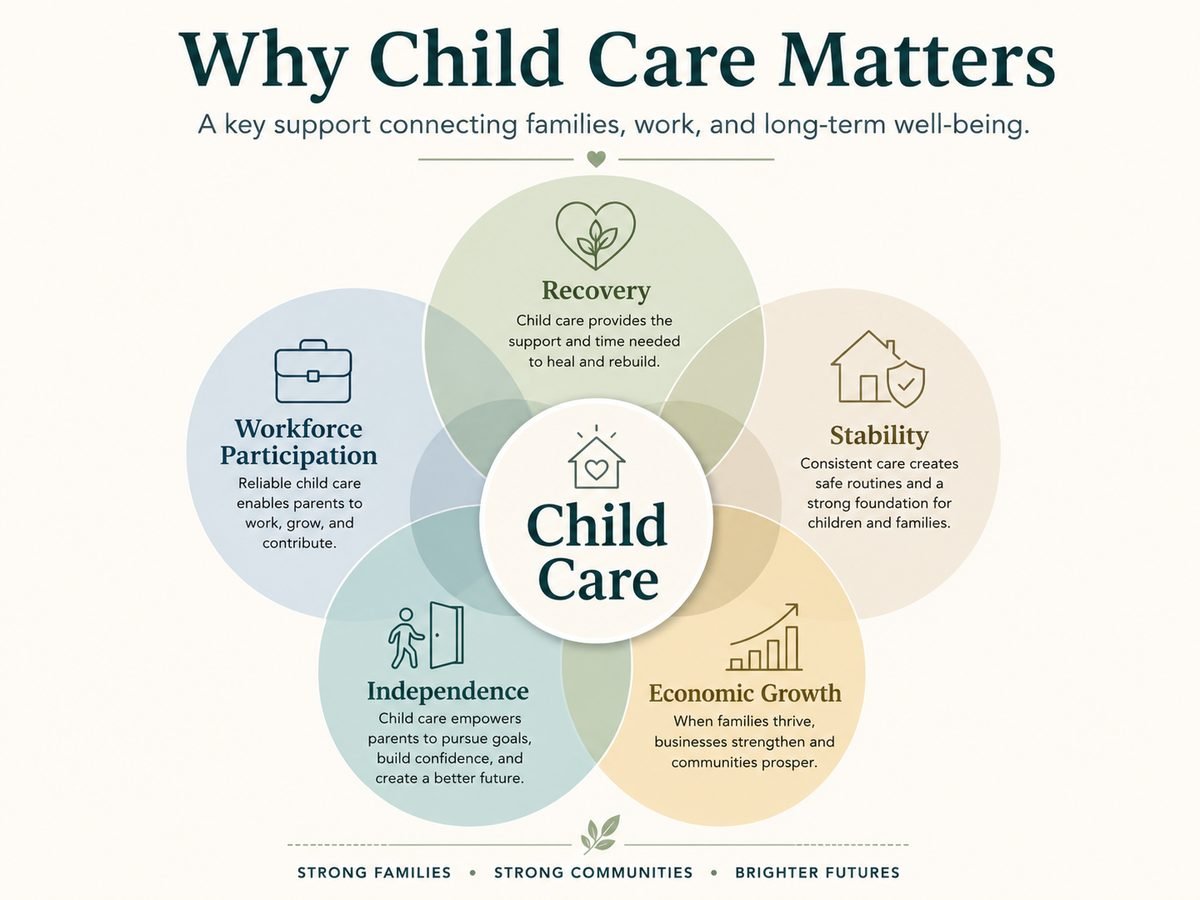
Child care may not be the first topic people think about when they think about addiction recovery. However, for parents, reliable child care can affect almost every part of daily stability. It can determine whether a parent can work, attend appointments, participate in treatment, go to school, complete training, operate a small business, or maintain a predictable family routine. In this sense, child care is not just a family service. It is part of the infrastructure that allows many parents to rebuild their lives.
This article is part of a Recover Clarity series examining child care, recovery, entrepreneurship, and self-sufficiency in West Virginia and Appalachia. The goal is not to claim that child care causes recovery. Because, it does not. Recovery is complex, personal, clinical, social, biological, and environmental. The more careful point is that child care can support access to resources associated with recovery stability.
Why I Am Writing About Child Care, Recovery, and Stability
This article is more personal than most topics I write about through Recover Clarity, but it is still grounded in research, policy, and professional experience.
Recover Clarity usually focuses on addiction treatment, recovery, medication-assisted treatment, mental health, holistic practices, and behavioral-health education. At first glance, child care policy may seem outside of that focus. However, the longer I have worked in behavioral health, education, workforce development, and small-business settings, the more clearly, I have seen that recovery does not happen in isolation.
People working to rebuild their lives are often trying to do many things at once. They may be trying to maintain employment, care for children, keep housing stable, rebuild family relationships, attend appointments, manage transportation, repair finances, and create a future that feels less fragile than in the past. For many families, child care is one of the practical supports that makes those goals possible.
This project began after questions arose about how West Virginia’s child care subsidy system treats self-employed parents, particularly parents who operate through a single-member LLC. As I looked closer, the issue became much larger than one policy rule or one business structure. It raised broader questions about how public systems support work, recovery, family stability, entrepreneurship, and long-term self-sufficiency.
My interest in this topic is also shaped by my own professional background. I have worked with individuals and families in West Virginia through behavioral health, education, workforce-related settings, and small-business experience. Across those roles, I repeatedly saw how employment, transportation, child care, recovery, family stress, and economic opportunity are connected. When one piece falls apart, several others can quickly become unstable.
That is why this topic belongs on Recover Clarity.
Recovery is not only about stopping substance misuse. Recovery is also about building a life that can be sustained. That life often depends on work, family stability, supportive relationships, predictable routines, safe housing, reliable transportation, and access to opportunity. Child care does not cause recovery, and it does not solve every problem. But for many parents, child care may help create the conditions that make stability more possible.
This article is not intended to be legal advice, tax advice, or a personal case study. It is intended to explain why child care should be understood as more than a family expense. In many situations, child care is part of the infrastructure that allows parents to work, attend treatment, pursue education, operate a business, and move toward long-term independence.
That is the larger issue this article explores and later blogs in this series will also show how child care can assist with development in the state, using neighboring state policies and statistics to support the claims.
Recovery Is More Than Treatment Attendance
Why Treatment Alone Is Not Enough
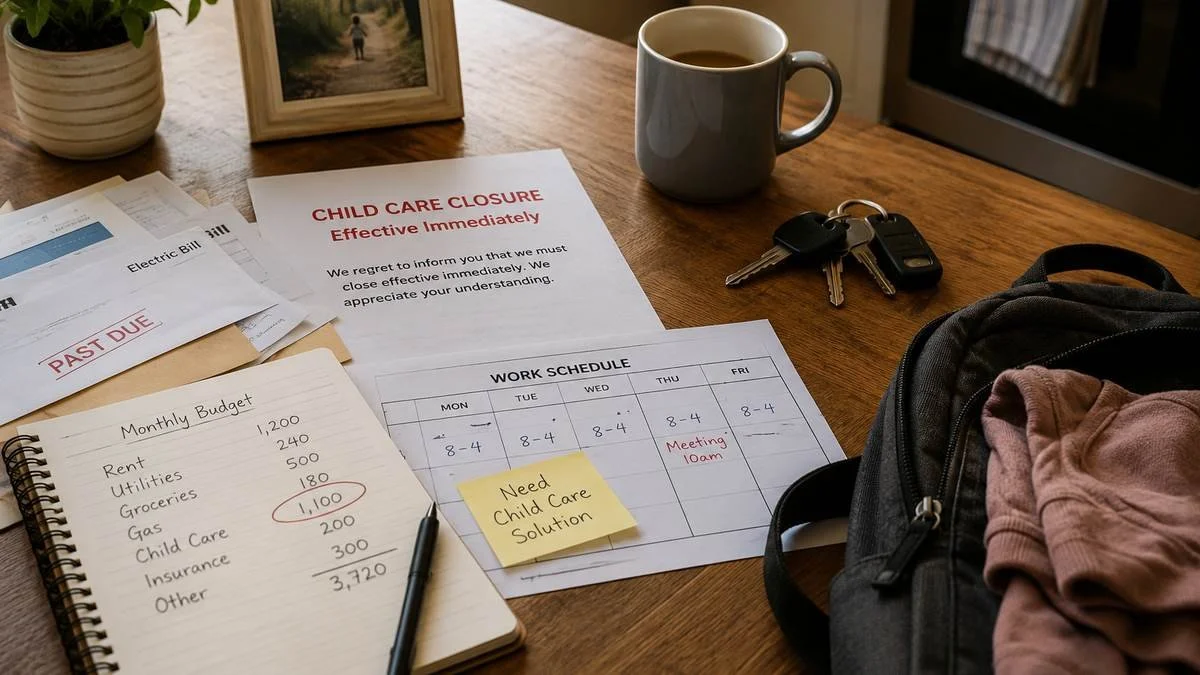
Very simple, treatment matters. Medication-assisted treatment (MAT), counseling, peer support, recovery coaching, psychiatric care, and harm-reduction services can all play important roles in recovery. But treatment is only one part of a person’s life. A parent may attend appointments but still be under constant pressure from unstable housing, transportation problems, family conflict, debt, unemployment, or lack of child care.
Recovery is easier to sustain when people have practical stability. That stability may include a safe place to live, reliable transportation, supportive relationships, access to health care, employment, meaningful activity, and family routines. When these supports are missing, recovery can become more fragile.
Recovery Capital
Recovery researchers often describe these supports through the concept of recovery capital. Recovery capital refers to the internal and external resources a person can use to begin and maintain addiction recovery. Foundational recovery-capital literature identified personal, social, and community resources as important to recovery, and current recovery-capital research continues to examine how these resources are measured and applied in treatment and recovery-support settings (Cloud & Granfield, 2008; Best & Hennessy, 2022; Bunaciu et al., 2024).
Recovery capital may include employment, housing, transportation, supportive family relationships, social support, education, health care, community connection, financial resources, and personal resilience. These resources do not guarantee recovery. They do, however, help explain why stability matters.
Child Care as a Recovery-Supportive Condition
Child Care Does Not Cause Recovery
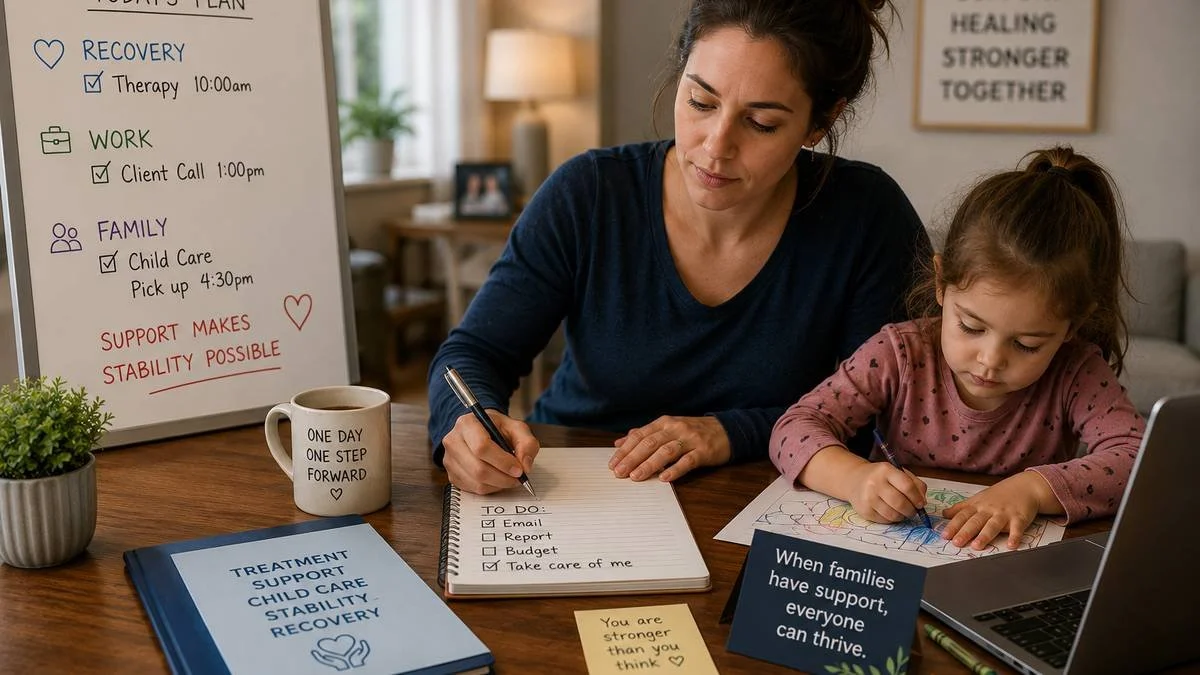
It is important to be precise. Child care does not treat addiction. Child care does not replace medication, counseling, peer support, or medical care. It should not be described as a direct cause of recovery. However, child care can influence whether a parent can access treatment, maintain employment, attend appointments, and preserve family routines.
For example, a parent may need child care to attend a medication appointment, group counseling session, court date, probation meeting, recovery meeting, job interview, shift at work, or school program. Without care, the parent may miss the appointment, lose hours, turn down opportunities, or become overwhelmed by competing responsibilities.
Why Practical Stability Matters
Recovery can be disrupted by ordinary practical problems. A missed shift can reduce income. Reduced income can affect transportation. Transportation problems can affect treatment attendance. Treatment disruption can affect mental health and recovery confidence. Family stress can increase. Children’s routines can become unstable.
This is why child care belongs in a broader recovery-stability discussion. It is not because child care is a clinical intervention. It is because child care may support the practical conditions that allow parents to remain engaged in treatment, work, parenting, and family life.
Child Care and Employment
Employment as Recovery Support
Parents in recovery are often trying to rebuild more than sobriety or symptom stability. They may also be trying to rebuild trust with children, maintain routines, manage school schedules, meet financial obligations, and provide emotional consistency. Family functioning can therefore be both a goal of recovery and a support for recovery.
Child care can contribute to family functioning by creating predictable routines. Children may benefit from consistent care, structured environments, and reliable daily schedules. Parents may benefit from the ability to work, attend appointments, and manage responsibilities without constant crisis decision-making.
Stress, Routines, and Stability
When child care is disrupted, a parent may face immediate and difficult choices. They may miss work, reduce hours, decline a contract, postpone treatment, use inconsistent caregivers, or attempt to work while supervising children. These choices can increase stress and reduce a parent’s sense of control.
Stress does not automatically cause relapse. However, stress can weaken recovery confidence, disrupt routines, and create conditions that make recovery harder to maintain. A recovery-oriented system should pay attention to these practical stressors because they shape the environment in which recovery occurs.
Why This Matters in West Virginia
A State Deeply Affected by Opioid Use Disorder
West Virginia has been among the states most deeply affected by the opioid epidemic. Communities across the state have invested in treatment, recovery services, peer support, workforce development, and family supports. Those investments recognize that recovery is not only about stopping substance misuse. It is also about rebuilding lives.
Recover Clarity serves patients in West Virginia who are working to maintain recovery, participate in the workforce, care for children, and create long-term stability. For these families, child care, employment, treatment access, and economic opportunity are not separate issues. They are connected in daily life.
Luckily there is some relief from the Opioid Epidemic in West Virginia as fatal overdoses have been on the decline, but the epidemic is not over. And there is a potential for a new opioid threat in that of Kratom, 7-OH, and MGM-15 the new opioid threat.
Workforce Participation and Recovery
West Virginia also faces workforce-participation and economic-mobility challenges. In a state where labor-force participation is already a major concern, policies that help parents remain employed or continue building income should be viewed as part of a broader stability strategy. Child care assistance is one of those policies.
The question is not whether every family should qualify for child care assistance forever. Public programs need eligibility rules, documentation requirements, and program-integrity protections. The question is whether those rules support or disrupt legitimate efforts to work, train, recover, and move toward self-sufficiency.
Why Child Care Policy Should Be Viewed Broadly
More Than Child Supervision
Child care is sometimes treated as a private family problem. That framing misses the broader role child care plays. Child care affects parents, employers, child care providers, schools, treatment programs, courts, small businesses, and communities. When parents cannot access care, other systems feel the effects.
For a parent in recovery, child care may help support treatment attendance, employment stability, family routines, and economic progress. For an employer, child care may affect attendance and retention. For a community, child care may affect labor-force participation and family stability.
Avoiding Overstatement
A credible discussion must avoid overstating the claim. Child care is not a recovery treatment. It is not the only factor shaping workforce participation. It is not a guarantee of family stability. But it can be one of the practical supports that allows parents to participate in the activities through which stability is built.
That is the central point. Child care may support recovery-related stability by making work, treatment, education, parenting routines, and economic participation more possible.
Practical Policy Questions
Questions for Agencies and Policymakers
Several questions follow from this perspective. How do child care policies affect parents who are working toward recovery and self-sufficiency? Do eligibility rules support treatment participation, work continuity, and family stability? Do administrative disruptions create avoidable instability for families already facing hardship? Can program integrity be protected while reducing barriers for legitimate working parents?
These questions are not partisan or ideological. They are practical. They ask whether public systems are aligned with the outcomes they are supposed to support.
Questions for Recovery Advocates
Recovery advocates should also pay attention to child care. When recovery is discussed only as treatment attendance, important barriers may be missed. A parent may want recovery, want employment, and want stability but still be blocked by lack of care. Recovery-oriented communities should recognize child care as part of the broader stability ecosystem.
What This Means for Treatment Providers
Screening for Practical Barriers
Behavioral health providers often screen for housing, transportation, insurance status, medication adherence, and mental health symptoms. Child care should be part of that practical-stability conversation. A parent may not volunteer that child care is the reason they missed an appointment, lost hours at work, or could not attend a group session. They may simply appear "noncompliant" or "inconsistent" when the actual barrier is logistical.
Asking about child care does not mean the treatment provider becomes responsible for solving the child care system. It means the provider better understands the patient’s recovery environment. If a parent is repeatedly missing appointments because care falls through, the clinical plan may need to account for that reality. This is where you see advantages of telehealth for the ability to work with those having problems making treatment requirements.
Recovery Planning Beyond the Appointment
Recovery planning should include the ordinary systems that make follow-through possible. A person may have motivation, medication, and a treatment plan, but still lack the practical supports needed to carry out that plan. Child care is one of those supports for parents.
A recovery plan that ignores child care may unintentionally ignore a major barrier to treatment participation. A workforce plan that ignores child care may unintentionally ignore a major barrier to employment. A family-stability plan that ignores child care may miss one of the systems that keeps daily life predictable.
How Families Experience Child Care Disruption
The Cascade Effect
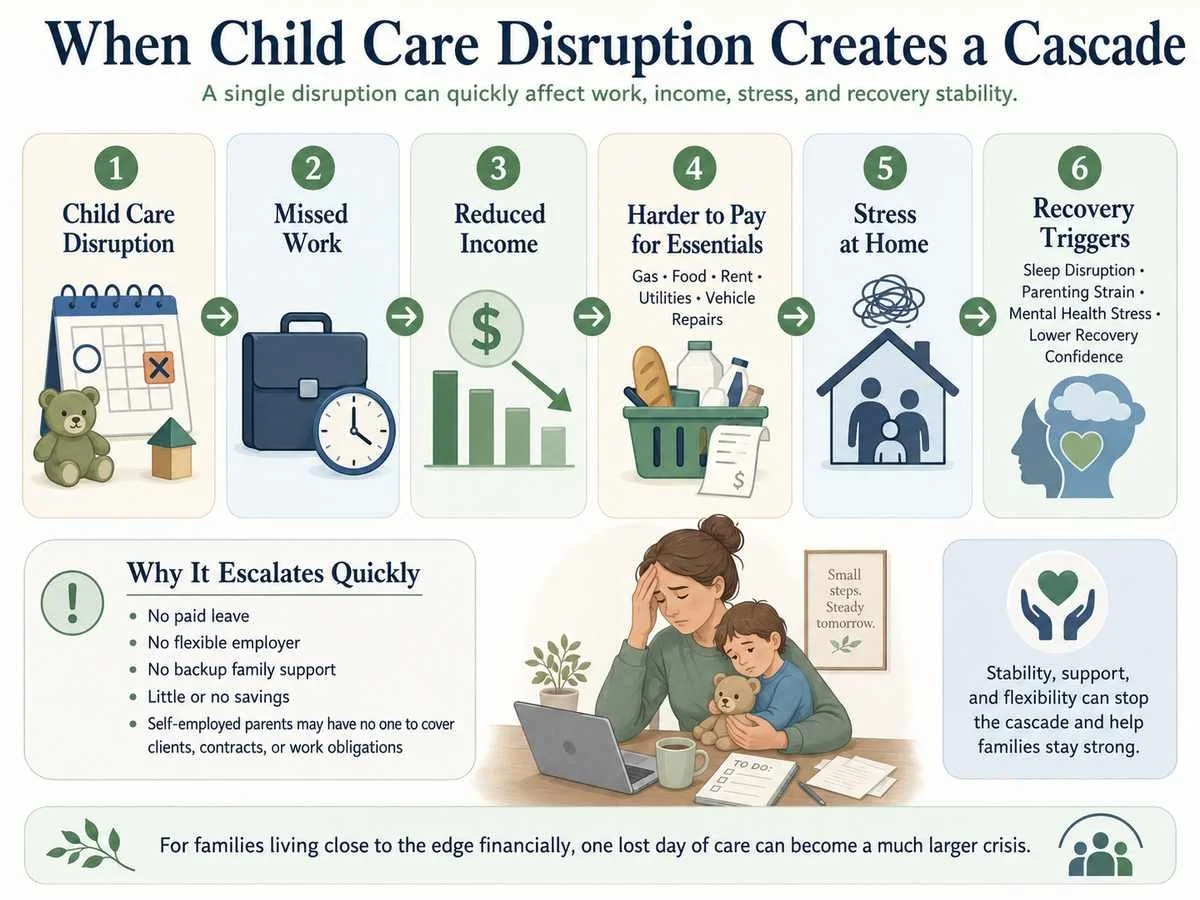
Child care disruption often does not remain one isolated problem. A parent loses care for a day, then misses work. Missed work can reduce income. Reduced income can make it harder to pay for gas, food, rent, utilities, or vehicle repairs. Those pressures can create stress at home. Stress can affect sleep, parenting, mental health, and recovery confidence. As it can be seen, these are all identifiable triggers in addiction recovery.
For families living close to the edge financially, this cascade can happen quickly. A parent may not have paid leave, a flexible employer, extended family support, or savings. A self-employed parent may not have anyone else who can cover work obligations. A missed contract or canceled client can become lost income and damaged reputation.
The Difference Between Support and Dependency
Some people wrongly assume that public support always discourages independence. In reality, supports such as child care assistance can help families work toward independence when designed well. A bridge is not the same thing as a destination. A family may need child care support while building the income, skills, work history, recovery stability, or business activity that eventually reduces reliance on assistance.
This is why child care policy should be evaluated in terms of outcomes. Does it help parents work? Does it help them attend training? Does it help them maintain treatment? Does it help families stabilize routines and move toward self-sufficiency? Those are the questions that matter.
Practical Examples of Child Care as Recovery Support
The Working Parent
Consider a parent who is stable in treatment and working a consistent schedule. The parent may be doing well clinically, but the treatment plan depends on the ability to keep employment, attend appointments, and manage children’s schedules. If child care ends abruptly, the parent may lose work hours, miss a medical appointment, or fall behind financially. None of those events is a relapse by itself, but each can weaken the stability that recovery depends on.
The Parent in Training or School
Another parent may be trying to complete a certification program or workforce-training course. That training may be the path toward higher income and reduced reliance on assistance. Without child care, the parent may be unable to attend class or complete required hours. A policy designed to support self-sufficiency should recognize that child care can make training participation possible.
The Self-Employed Parent
A self-employed parent may need care during direct work hours and during unpaid business tasks. The parent may be answering calls, buying supplies, preparing invoices, scheduling jobs, traveling to clients, or completing tax records. If child care policy does not recognize these activities as part of legitimate work, the parent may lose the ability to maintain the business that is helping the family move toward independence.
Why Self-Employment and LLCs Matter for Parents in Recovery
For many parents, work is not only about income. Work can also provide structure, purpose, identity, accountability, social connection, and a sense of progress. For people in recovery, those factors may be especially important. Employment is often discussed as part of recovery support because it can help people rebuild routines, strengthen confidence, improve financial stability, and reconnect with community life (Substance Abuse and Mental Health Services Administration [SAMHSA], 2021; U.S. Department of Labor, n.d.).
However, not every parent in recovery can easily enter traditional employment. Many people rebuilding their lives after having a substance use disorder face barriers that make the standard job market difficult to access. These barriers may include gaps in employment, limited recent work history, stigma, transportation challenges, lack of credentials, child care responsibilities, or criminal records. The National Institute of Justice has long recognized that criminal records can create barriers to employment and other forms of reentry, and the U.S. Department of Labor’s Recovery-Ready Workplace materials also recognize the importance of second-chance hiring and employment supports for people in recovery (National Institute of Justice, 2012; U.S. Department of Labor, n.d.).
That is one reason self-employment matters.

For some individuals, starting a small business may be one of the few realistic ways to rebuild work history, generate income, and regain a sense of independence. A person who may struggle to be hired by a traditional employer may still be able to provide landscaping services, do repair work, offer peer-support services, provide transportation, sell products, perform contract work, or build another service-based business. That business may start small, but it can still represent real work, real responsibility, and real movement toward self-sufficiency.
Self-employment can also carry emotional and psychological meaning. Building a business can provide a sense of pride, ownership, identity, and personal agency. For someone in recovery, this may matter deeply. Recovery often involves rebuilding a life that feels stable, meaningful, and self-directed. A small business can become part of that rebuilding process by allowing a person to see evidence of progress: clients served, bills paid, appointments kept, supplies purchased, employees helped, taxes filed, and goals met.
This does not mean entrepreneurship is easy or appropriate for everyone. Running a business can be stressful, uncertain, and financially risky. But for some parents, self-employment may be a bridge between past instability and future opportunity.
That is where the LLC issue becomes important.
A limited liability company, or LLC, is a common business structure. The U.S. Small Business Administration explains that LLCs can provide personal liability protection and separate personal assets from business risks in many circumstances (U.S. Small Business Administration, n.d.). The IRS also explains that, for federal income tax purposes, a single-member LLC is generally treated as disregarded as separate from its owner unless it elects to be treated as a corporation. In many cases, the business activity of an individual owner is reported on the owner’s federal tax return in a way similar to sole-proprietor activity (Internal Revenue Service, n.d.).
In plain language, forming a single-member LLC does not necessarily mean someone has a large company, high income, or major assets. Many single-member LLCs are very small businesses operated by one person. The LLC may simply be a way to create liability protection, open a business bank account, appear more professional to customers, obtain insurance, enter contracts, or keep business finances organized.
For parents in recovery or parents trying to rebuild economic stability, that formal structure can matter. It can help them feel legitimate. It can help them separate business from personal life. It can help them take the business seriously. It can also help protect a family from unnecessary personal risk.
This is why child care policy should be careful not to treat LLC ownership as if it automatically means a parent is financially secure or no longer needs support. A parent may be operating a small single-member LLC, still have low income, still be working toward stability, and still need child care in order to keep working. All of the neighboring states to West Virginia allows for and often support LLC structure, even some allowing corporation structures, and evaluate child care subsidies on income alone. To learn more about how other states look at these subsidies, read the following blogs in this series.
Child care assistance, in this context, is not simply paying for supervision. It may be helping a parent maintain work, continue recovery-supportive routines, serve customers, build income, and move toward long-term independence.
For many families, especially those affected by recovery, poverty, employment barriers, or small-business instability, the question should not be whether a parent chose the “right” business label. The better question is whether the parent is engaged in legitimate work, whether income is within program limits, whether the work can be documented, and whether child care is necessary to keep that work going.
A Recovery-Oriented Community Lens
Recovery Is Built in Ordinary Life
Recovery-oriented communities often emphasize hope, connection, opportunity, and meaningful participation. Those values sound broad, but they are built in ordinary daily life. A parent gains confidence by showing up for work. A family rebuilds trust through consistent routines. A person strengthens recovery by keeping appointments and reducing crisis-based decisions. Child care can support these ordinary forms of stability.
Policy Should Reduce Avoidable Instability
Public systems cannot eliminate every barrier. They cannot guarantee recovery, employment, or family success. But they can avoid creating unnecessary instability when a family is already working toward progress. A child care policy that recognizes legitimate work, including self-employment, can support stability while still requiring documentation and accountability.
Conclusion: Child Care Is Part of the Stability Families Need to Rebuild
Recovery is not built through treatment alone. Treatment matters, but long-term recovery is also shaped by the daily conditions that make stability possible: work, transportation, housing, family routines, social support, financial security, and access to opportunity.
For parents, child care often sits at the center of those conditions.
Reliable child care can allow a parent to work, attend appointments, participate in treatment, pursue education, build skills, or operate a small business. Without it, even a motivated parent may be forced into crisis-based decisions: missing work, reducing hours, losing income, turning down opportunities, or struggling to maintain recovery-supportive routines.
That is why child care should be understood as more than a family expense. For many families, it is part of the infrastructure that makes employment, recovery stability, parenting, and long-term self-sufficiency possible.
This becomes especially important for self-employed parents.
For some people in recovery, self-employment may be a bridge back into work when traditional employment is difficult to access. Gaps in employment, criminal records, stigma, transportation barriers, child care responsibilities, and limited recent work history can all make it harder to be hired by a traditional employer. Starting a small business may provide a path toward income, structure, pride, responsibility, and independence.
In that context, forming a single-member LLC should not automatically be viewed as a sign that a parent is financially secure or no longer needs support. Many LLCs are very small businesses operated by one person. The LLC may simply help the parent separate business and personal finances, protect against liability, appear more professional to customers, obtain insurance, open a business bank account, or organize the business in a more responsible way.
For a parent trying to rebuild life after instability, those steps can matter. They may represent progress, not privilege.
A parent who is self-employed through an LLC may still have low income. They may still be building stability. They may still need child care in order to work. They may still be attempting to move toward long-term independence.
That is the larger issue.
If child care policies support parents who are working, training, attending school, or rebuilding stability, then those policies should also carefully consider how modern self-employment works. The key questions should be whether the parent is engaged in legitimate work, whether income falls within program limits, whether the work can be documented, and whether child care is necessary to keep that work going.
Child care does not cause recovery. It does not guarantee employment. It does not make every small business successful.
But child care may help create the conditions in which recovery, employment, parenting, and self-sufficiency become more sustainable.
For families trying to rebuild their lives, especially in communities affected by poverty, substance use disorders, workforce barriers, and limited opportunity, that distinction matters.
References
Administration for Children and Families. (2024). 2024 Child Care and Development Fund (CCDF) final rule: Improving child care access, affordability, and stability in the Child Care and Development Fund. U.S. Department of Health and Human Services.
Araujo, V., McBride, L., & Sandler, D. H. (2025). The impact of childcare costs on mothers' labor force participation (CES Working Paper No. 25-25). U.S. Census Bureau, Center for Economic Studies.
Best, D., & Hennessy, E. A. (2022). The science of recovery capital: Where do we go from here? Addiction, 117(4), 1139-1145.
Bunaciu, A., Bliuc, A.-M., Best, D., Hennessy, E. A., Belanger, M. J., & Benwell, C. S. Y. (2024). Measuring recovery capital for people recovering from alcohol and drug addiction: A systematic review. Addiction Research & Theory, 32(3), 225-236.
Cloud, W., & Granfield, R. (2008). Conceptualizing recovery capital: Expansion of a theoretical construct. Substance Use & Misuse, 43(12-13), 1971-1986.
Internal Revenue Service. (n.d.). Single member limited liability companies. https://www.irs.gov/businesses/small-businesses-self-employed/single-member-limited-liability-companies
National Institute of Justice. (2012). In search of a job: Criminal records as barriers to employment. U.S. Department of Justice.
Substance Abuse and Mental Health Services Administration. (2021). Substance use disorders recovery with a focus on employment and education. U.S. Department of Health and Human Services.
U.S. Department of Health and Human Services. (2024). Improving child care access, affordability, and stability in the Child Care and Development Fund (CCDF). Federal Register, 89(42), 15366-15446.
U.S. Department of Labor. (n.d.). Recruitment and employment of people in recovery. Recovery-Ready Workplace Resource Hub. https://www.dol.gov/agencies/eta/RRW-hub/Getting-started/Recruitment-employment
U.S. Department of Labor. (n.d.). Addressing stigma. Recovery-Ready Workplace Resource Hub. https://www.dol.gov/agencies/eta/RRW-hub/Getting-started/Addressing-stigma
U.S. Small Business Administration. (n.d.). Choose a business structure. https://www.sba.gov/business-guide/launch-your-business/choose-business-structure