

Entrepreneurship, Small Business, and Self-Sufficiency in Appalachia

If you are first landing on this blog, please read the first part in this series Child Care, Recovery, and Stability: Why Family Supports Matter Beyond Child Care. This is a three-part series addressing how child care is important in general but also based on how this plays an important role in addiction recovery.
Entrepreneurship is often described in big language: innovation, growth, investment, job creation, and economic development. Those ideas matter, but they can make entrepreneurship sound distant from ordinary family life. For many small-business owners, entrepreneurship is much more practical. It is a way to work, earn income, build skills, serve customers, and move toward independence.
In Appalachia, that practical understanding of entrepreneurship is especially important. Many communities face challenges related to labor-force participation, population loss, transportation barriers, rural geography, limited access to capital, and fewer nearby employment options. In that context, a small business may be more than a private enterprise. It may be a pathway into work for the owner, a source of employment for others, and a stabilizing resource for the local community.
This article is part of a Recover Clarity series on child care, recovery, entrepreneurship, and self-sufficiency. The focus here is entrepreneurship: why it matters, how it relates to stability, why business structure matters, and why child care can affect whether self-employed parents are able to maintain and grow their businesses.
Entrepreneurship Is Not a Shortcut
Business Ownership Is Hard
It is important not to romanticize entrepreneurship. Starting and operating a business can be stressful, risky, and financially uncertain. Small-business owners may deal with irregular income, delayed payments, taxes, insurance, bookkeeping, licensing, hiring, firing, customer complaints, supply costs, vehicle expenses, debt, and long hours. Many small businesses struggle, and some fail.
For that reason, entrepreneurship should not be presented as the solution for every family. Some people are better served by traditional employment, education, apprenticeships, public-sector work, union jobs, or other career paths. Business ownership is one pathway, not the only pathway.
Still, Entrepreneurship Can Be a Real Pathway
Even with those cautions, entrepreneurship can be a legitimate route toward self-sufficiency. A person may start with a small service business and gradually build customers, reputation, income, equipment, skills, and relationships. The business may begin as a one-person operation and later create part-time or full-time jobs. It may remain modest but still provide meaningful income and independence.
In regions where traditional employment is limited or inflexible, self-employment may be one of the few realistic ways for a person to participate in the economy. This can be especially true for parents, people in recovery, individuals with criminal histories, people with employment gaps, and people living in rural communities. This is particularly true for those individuals living in West Virginia, which is where the base of this blog series takes root, as well as where many of the patients at Recover Clarity reside.
Entrepreneurship Builds More Than Income
Human Capital
Business owners learn by doing. They learn how to communicate with customers, estimate jobs, schedule work, manage money, keep records, solve problems, buy supplies, maintain equipment, and comply with tax and insurance requirements. These skills are forms of human capital. Foundational economic theory has discussed human capital for decades, and current labor-market research continues to emphasize skills, adaptability, and learning as important to opportunity (Becker, 1964; Deming & Silliman, 2024).
A small-business owner may not describe these activities as human-capital development. But that is what is happening. A person who builds a business is also building practical skills that may support future employment, business growth, leadership, and independence. And these skills can assist them in life in general as well as the growth can build a sense of identity and pride, something that is beneficial in a recovery journey (or any life journey).
Social Capital
Entrepreneurship also builds relationships. Small-business owners rely on customers, referrals, vendors, employees, subcontractors, mentors, family support, professional networks, and community reputation. These relationships are forms of social capital. Older sociology literature helped define social capital, and current recovery and community research continues to emphasize the importance of social resources and supportive networks (Coleman, 1988; Putnam, 2000; Islam et al., 2023; Meisel et al., 2024). And support systems are crucial to addiction recovery as mentioned in the blog Developing a Comprehensive Plan for Lasting Recovery.
In Appalachian communities, reputation and relationships can be especially important. Many businesses grow through word of mouth. A trusted local provider may serve families, churches, offices, property managers, contractors, and community organizations. That trust can become part of the local economy.
Psychological Capital
Business ownership can also build confidence. A person who successfully serves customers, solves problems, earns income, and manages responsibilities may develop hope, resilience, optimism, and self-efficacy. These are components of psychological capital, a framework developed in organizational psychology and still used in workplace well-being discussions today (Luthans et al., 2007; American Psychological Association, 2023).
For individuals rebuilding after addiction, incarceration, unemployment, poverty, or family disruption, this confidence can matter. It can help people believe that their effort produces results. It can support persistence through setbacks. And having success in other areas of life can provide that confidence needed to exceed in others, such as that of recovery.
Financial Capital
Entrepreneurship may also build financial capital. Financial capital includes income, savings, equipment, credit access, business equity, vehicles, tools, inventory, insurance, contracts, and working capital. These resources can help families withstand emergencies and invest in future growth. This is where the LLC formation becomes a critical factor in this blog series, which was started due to a child care subsidy policy in West Virginia, not supporting LLC formation.
The Appalachian Regional Commission has identified access to capital and credit as an important issue for entrepreneurs and small businesses in Appalachia (Appalachian Regional Commission, 2024a). That matters because business growth often requires financing, credit history, documentation, formal records, and continuity.
Business Structure Matters

Why Small Businesses Form LLCs
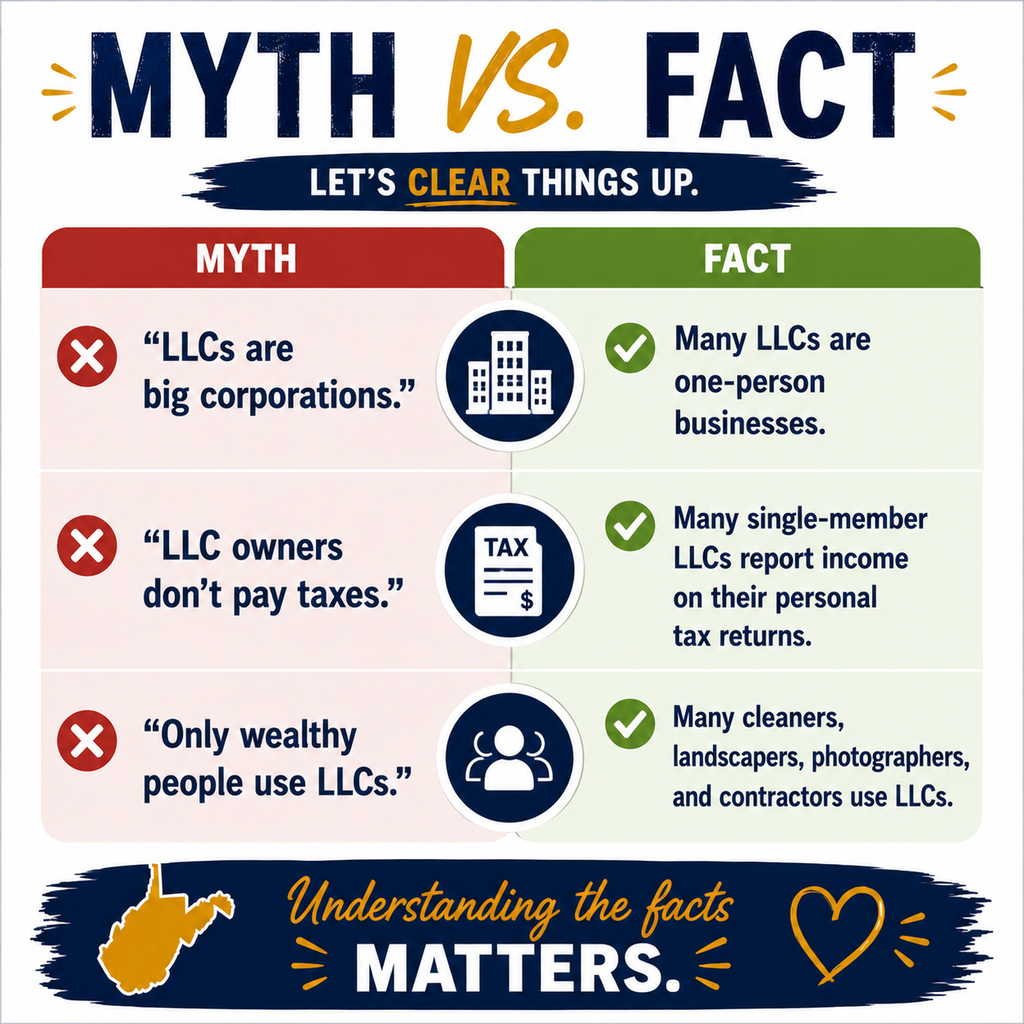
Many small businesses begin informally or as sole proprietorships. Over time, an owner may form a limited liability company (LLC) or they may take the security of having a LLC at the start of the formation of their business. This does not necessarily mean the business is large, wealthy, or financially secure. Many single-member LLCs are still one-person businesses with modest income.
An LLC may be created for liability protection, business banking, customer credibility, insurance, contracting, recordkeeping, or preparation for future financing. The SBA describes LLCs as a common structure that can protect personal assets in many instances (U.S. Small Business Administration, 2025). The IRS explains that, for federal income tax purposes, a single-member LLC is generally treated as disregarded as separate from its owner unless it elects corporate treatment (Internal Revenue Service, 2025).
This distinction is important. A single-member LLC may look very similar to a sole proprietorship in terms of income, work activity, and having one or only a few employees. The difference may be legal structure and liability protection rather than economic reality.
An LLC Does Not Mean a Business Is Profitable
One of the most important misunderstandings about small-business ownership is the assumption that having an LLC means the business owner is financially secure.
That assumption is often wrong.
Many people start a small business or form an LLC with the hope that the business will eventually grow. In the beginning, the business may produce little income, no profit, or even a financial loss. A person may spend months or years building customers, purchasing supplies, paying for insurance, buying equipment, covering transportation, paying registration fees, marketing services, and trying to become stable enough to generate consistent income.
This is especially true for very small service-based businesses. A single-member LLC might be a photographer, party decorator, cleaner, landscaper, contractor, consultant, mobile service provider, online seller, or home-based business owner. The business may exist legally, but that does not mean it is profitable. In some cases, the owner may be putting more money into the business than they are taking out.
This distinction matters for child care policy.
If an agency searches a parent’s name, finds an LLC registration, and treats that registration as evidence that the parent is categorically different from another self-employed worker, the analysis may miss the economic reality of the business. The LLC may be new. It may be operating at a loss. It may have only a few customers. It may exist because the owner was trying to protect personal assets, open a business bank account, obtain insurance, appear professional to customers, or create a more legitimate business structure.
Federal small-business guidance recognizes that new businesses need significant planning and financial runway. The U.S. Small Business Administration advises entrepreneurs to calculate startup costs and monthly expenses and notes that counting at least one year of monthly expenses is important, while estimating several years is ideal for planning purposes (U.S. Small Business Administration, 2024). That guidance reflects a practical reality: businesses often require time, investment, and stability before they become financially secure.
Business survival data also show why LLC ownership should not be equated with wealth. The U.S. Bureau of Labor Statistics reported that only about one-third of private-sector business establishments born in 2013 were still operating in 2023, meaning many new businesses do not survive long term (U.S. Bureau of Labor Statistics, 2024). The SBA’s 2024 small-business FAQ similarly reports that more than half of establishments close before five years, while survival rates improve after a business becomes more established (U.S. Small Business Administration Office of Advocacy, 2024).
That does not mean small businesses should be discouraged. It means early-stage small businesses should be understood accurately. Starting a business is often a process of building toward stability, not proof that stability already exists.
This point is especially important in rural and Appalachian communities. The Appalachian Regional Commission’s 2024 report on access to capital and credit for entrepreneurs and small businesses in Appalachia identified barriers affecting capital flow and small-business development across the region (Appalachian Regional Commission, 2024a). Rural entrepreneurs may face challenges related to limited markets, fewer nearby lenders, transportation barriers, smaller customer bases, weaker broadband access, and fewer business-support resources. Those conditions can make the path to profitability slower and more fragile.
For a parent trying to build a small business, child care can be part of what allows the business to continue long enough to become viable. Without child care, the parent may not be able to meet clients, complete jobs, purchase supplies, respond to calls, prepare invoices, travel to work sites, or perform the unpaid administrative work that keeps a business alive.
That is why LLC ownership should not automatically be treated as evidence that a parent no longer needs support. A single-member LLC may represent ambition, formalization, risk management, and the hope of future growth. It may not represent current wealth.
A more accurate policy question would be:
Is the parent engaged in legitimate work?
Is the business income within program limits?
Can the work activity and income be documented?
Is child care necessary for the parent to continue working?
Those questions focus on economic reality rather than business label alone.
For families working toward self-sufficiency, that distinction matters. A parent should not be penalized simply for taking responsible steps to formalize a small business before that business has become profitable.
LLC Does Not Mean Wealthy
A person can own an LLC and still be low income. A person can own an LLC and still need child care assistance. A person can own an LLC and still have irregular income, business debt, limited savings, and financial vulnerability.
Treating LLC ownership as evidence that a family does not need support misunderstands how many small businesses operate. In many cases, forming an LLC is not a sign of wealth. It is a step toward formalization and risk management.
Entrepreneurship and Child Care
Business Work Is Not Always Hourly
Self-employment does not always look like traditional work. An employee may have a schedule and pay stub. A business owner may have invoices, contracts, estimates, travel time, supply runs, administrative work, marketing, bookkeeping, phone calls, client messages, hiring tasks, and delayed payments.
Some of this work happens before income arrives. A business owner may spend time bidding on jobs that are not yet paid, following up with customers, organizing supplies, maintaining insurance, cleaning equipment, training workers, or preparing invoices. These tasks are still part of the business.
Parents Need Care to Operate Businesses
A self-employed parent may need child care not only during direct service hours, but during administrative work necessary to keep the business alive. For example, a cleaning business owner may need care while traveling to job sites, supervising staff, buying supplies, communicating with clients, or preparing payroll. A contractor may need care while writing estimates, picking up materials, or handling billing. A therapist or consultant may need care while documenting, scheduling, or completing administrative duties.
If child care policy recognizes only narrow forms of work, it may fail to capture the reality of small-business operations.
Why This Matters in Appalachia

Small Businesses as Community Infrastructure
In many Appalachian communities, small businesses provide essential services. They clean buildings, repair homes, transport goods, mow lawns, provide child care, serve food, support construction, offer health services, and maintain local property. These businesses circulate money locally and build community relationships.
The Appalachian Regional Commission has described small businesses as contributors to Appalachia’s economic and cultural vitality and has studied barriers affecting capital access for regional entrepreneurs (Appalachian Regional Commission, 2024a, 2024b). This supports the idea that entrepreneurship is not a side issue. It is part of regional economic resilience.
Opportunity for People Facing Barriers
Small businesses may also provide opportunities for individuals who face barriers in traditional employment. A local owner may be more willing than a large employer to consider a person’s story, work ethic, recovery progress, or community reputation. Self-employment may also allow a person to rebuild work history after gaps or setbacks.
This matters in recovery-oriented communities. Employment and meaningful activity can support stability. Business ownership can create identity, structure, responsibility, and connection. Again, entrepreneurship is not treatment. But it can be part of the environment in which recovery and self-sufficiency become more possible.
Public Policy and Business Formalization
Policies Can Encourage or Discourage Formality
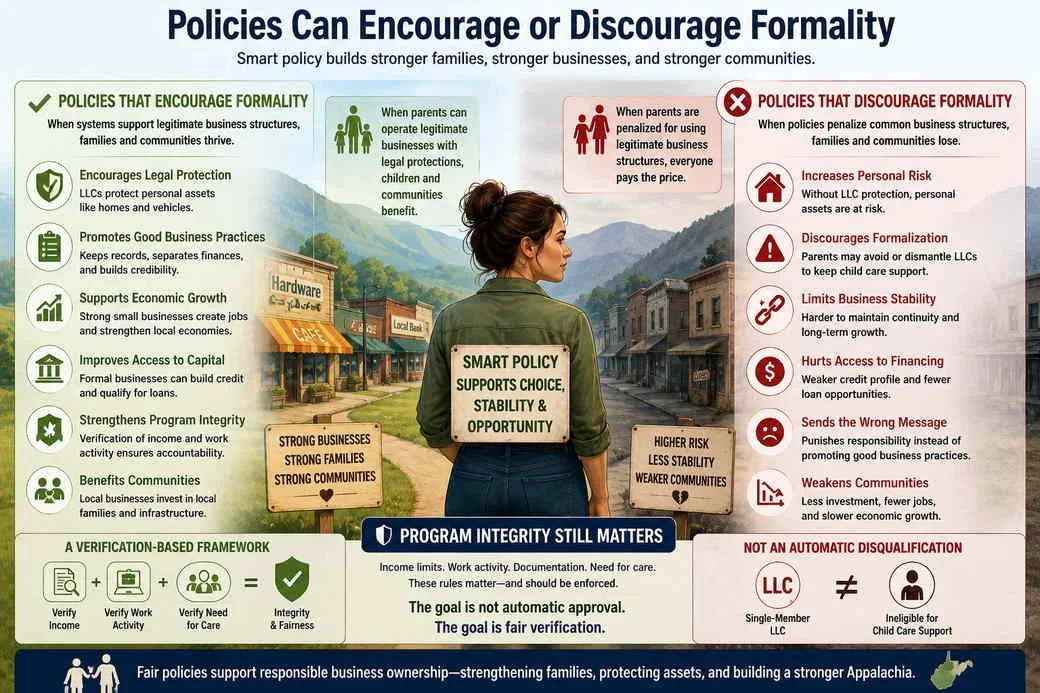
Public systems often encourage people to formalize businesses, keep records, pay taxes, open business bank accounts, obtain insurance, and build credit. These are positive steps for economic development and program integrity.
However, if a child care policy favors sole proprietorship while excluding single-member LLC ownership, it may send the opposite signal. A parent may feel pressured to avoid formal business structure or dismantle an LLC in order to maintain child care support. That can reduce liability protection, business continuity, credibility, and future financing opportunities.
Program Integrity Still Matters
None of this means every business owner should automatically qualify for child care assistance. Income limits, work activity, household composition, documentation, and need for care still matter. Agencies must prevent improper payments and ensure that applicants meet program rules.
The better question is whether common business structures should be automatically disqualifying when income and work activity can be verified. A verification-based framework can protect program integrity while still recognizing legitimate self-employment.
The Role of Child Care in Business Continuity

Administrative Work Is Still Work
One misunderstanding about self-employment is the idea that only paid service time counts as work. In reality, business owners spend significant time on tasks that do not immediately produce a check but are necessary for the business to continue. They answer calls, write estimates, buy supplies, respond to complaints, handle invoices, reconcile payments, schedule jobs, prepare tax documents, maintain equipment, and communicate with workers or subcontractors. Even writing this blog is part of this author’s and business owner of Recover Clarity’s work that does not count as traditional work but is part of growing a website to assist with Search Engine Optimization (SEO) growth. Just another example of work small business owners has to perform.
For a parent, these tasks still require time and concentration. They may also require travel, phone calls, computer access, or meetings with clients. Without child care, the owner may have to delay or skip administrative duties. Over time, delayed administration can damage the business just as much as missed service hours.
Delayed Payments and Irregular Income
Small-business income is often irregular. A business may complete work in one month and receive payment weeks later. A client may delay payment. A contract may require supplies before revenue arrives. A business may look active on paper but still have short-term cash-flow problems. These realities make self-employment different from wage employment.
Child care policy should recognize that legitimate business activity may not always produce immediate, evenly distributed income. Verification can still occur through invoices, bank records, contracts, ledgers, tax forms, work logs, and business records. But the verification process should be designed around the real way small businesses function.
Second-Chance Employment and Community Impact
Small Businesses Can Create Flexible Opportunities
Small businesses often know their communities. They may be willing to hire someone based on local reputation, effort, or personal growth rather than only formal credentials. This can matter for individuals with criminal records, recovery histories, employment gaps, or other barriers. Because of this is another reason why this topic is important to individuals in addiction treatment especially in the state of West Virginia.
A small business that survives may later become a second-chance employer. It may give someone part-time work, flexible hours, mentorship, or a chance to rebuild trust. These opportunities are not always captured in economic data, but they matter in community life.
Local Economic Circulation
Small businesses also circulate money locally. A local cleaning company buys supplies, pays workers, purchases gas, uses local banks, serves local offices, and pays local taxes. A contractor, landscaper, home-care provider, or repair business may do the same. When small businesses grow, the benefits can extend beyond the owner.
That is why policies affecting small-business continuity should be evaluated carefully. A child care rule that interrupts a parent’s ability to operate a business can affect customers, employees, providers, and local economic activity. It may be a small disruption on paper but a large disruption in daily life.
Why Formalization Should Be Encouraged
Records, Taxes, and Program Integrity
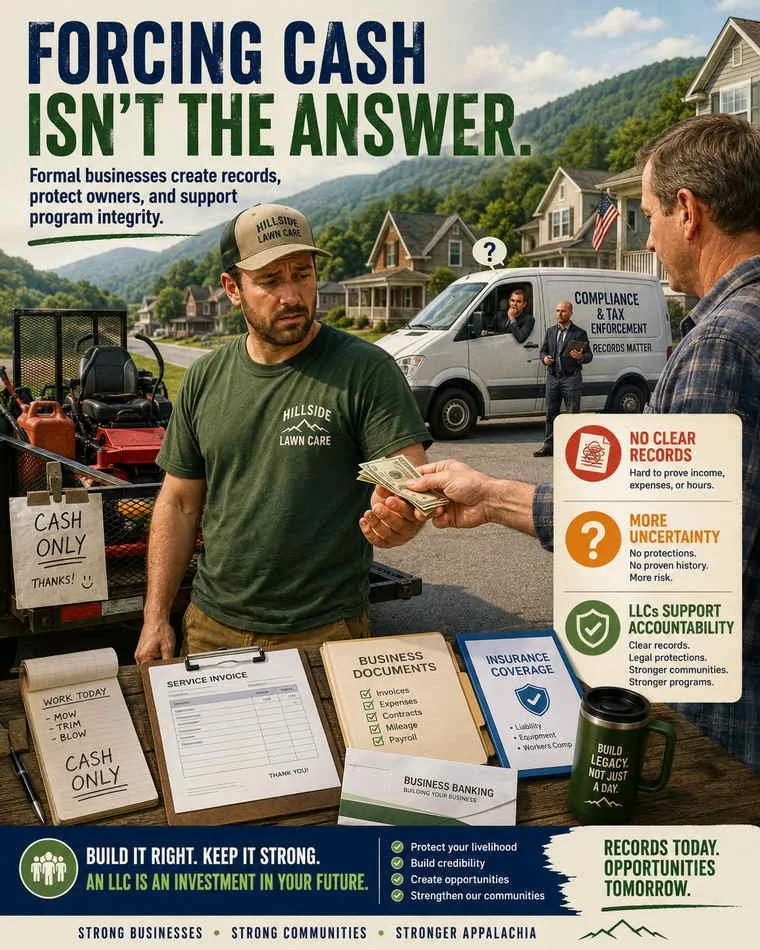
Formal business structures can actually support program integrity. An LLC owner may keep better records, maintain separate bank accounts, file taxes, purchase insurance, and document income more clearly than an informal cash-based business. These records can help agencies verify income and work activity.
If policy discourages formalization, it may unintentionally push people toward less formal arrangements. That is not good for the business owner, the agency, or the public system. A better approach is to encourage documentation and formal records while evaluating eligibility based on income, activity, and need for care.
The Signal Sent to Small-Business Owners
Public policy sends signals. If a state says entrepreneurship matters but then treats a common small-business structure as disqualifying for child care support, the signal becomes confusing. Parents may wonder whether they are supposed to build formal businesses or avoid formalization to preserve eligibility. Or even stop the idea of creating their own business altogether.
A consistent self-sufficiency framework would support work, documentation, tax compliance, business records, and gradual movement toward independence. That does not require automatic eligibility for every business owner. It requires a verification-based approach that recognizes legitimate self-employment.
What This Means for Child Care Policy
Self-Employment Should Be Verified, Not Dismissed
The strongest child care policy is not one that automatically approves every self-employed applicant. It is one that asks for appropriate proof. That proof might include tax returns, invoices, bank deposits, profit-and-loss statements, ledgers, client records, contracts, work logs, or business licenses. A parent who cannot document work activity may not qualify. But a parent who can document work activity should not be dismissed simply because the business uses a common legal structure. In the following blog in this series will examine the surrounding states such as Pennsylvania, Maryland, Virginia, and Kentucky which have taken such an approach to child care subsidies.
Policy Should Match Modern Work
Modern work includes wage employment, gig work, contract work, home-based businesses, service businesses, seasonal work, part-time self-employment, and formal small-business ownership. Child care policy should be able to evaluate these arrangements without forcing all legitimate work into one outdated model.
A verification-based approach is more flexible and more realistic. It allows agencies to protect program funds while recognizing that many families are trying to build stability through nontraditional work. That flexibility is especially important in rural and Appalachian communities, where opportunity often looks different from traditional urban employment.
Supporting the Bridge to Independence
Child care assistance should be viewed as a bridge to independence, not as the opposite of independence. When a parent is working or building a business, child care may be the support that allows income to grow. Removing that support too early can interrupt the very progress the program is designed to encourage.
Conclusion
Entrepreneurship is one pathway toward self-sufficiency. It is not easy, guaranteed, or appropriate for everyone. But for some families in Appalachia, it may be a practical route into work, income, skill development, community connection, and long-term stability.
Child care can determine whether that pathway remains open. A self-employed parent may need care to work, travel, meet customers, manage employees, complete paperwork, and grow the business. If policy disrupts child care because of entity structure alone, it may undermine the very self-sufficiency goals public programs often seek to support. Or if child care is removed from an established business, it can cause the owner to layoff or fire staff, reduce revenue in the economy, and cause more strain on assistance programs.
For West Virginia and Appalachia, this is not only a business issue. It is a workforce issue, a family-stability issue, an economic-mobility issue, and, for many families, a recovery-supportive stability issue.
References
American Psychological Association. (2023). Psychological capital: The positive resource for employee well-being. https://www.apa.org/topics/healthy-workplaces/psychological-capital
Appalachian Regional Commission. (2024a). Access to capital and credit for entrepreneurs and small businesses in Appalachia. https://www.arc.gov/report/access-to-capital-and-credit-for-entrepreneurs-and-small-businesses-in-appalachia/
Appalachian Regional Commission. (2024b, April 23). Small businesses are driving economic vitality in Appalachia. https://arc.gov/news/small-businesses-are-driving-economic-vitality-in-appalachia/
Becker, G. S. (1964). Human capital: A theoretical and empirical analysis, with special reference to education. University of Chicago Press.
Coleman, J. S. (1988). Social capital in the creation of human capital. American Journal of Sociology, 94, S95-S120.
Deming, D. J., & Silliman, M. I. (2024). Skills and human capital in the labor market (NBER Working Paper No. 32908). National Bureau of Economic Research.
Federal Reserve Banks. (2024). 2024 report on startup firms: Findings from the 2023 Small Business Credit Survey for new nonemployer and employer firms.
Internal Revenue Service. (2025). Single member limited liability companies. https://www.irs.gov/businesses/small-businesses-self-employed/single-member-limited-liability-companies
Islam, M. F., Guerrero, M., Nguyen, R. L., Porcaro, A., Cummings, C., Stevens, E., & Jason, L. A. (2023). The importance of social support in recovery populations: Toward a multilevel understanding. Alcoholism Treatment Quarterly, 41(2), 222-236.
Luthans, F., Youssef, C. M., & Avolio, B. J. (2007). Psychological capital: Developing the human competitive edge. Oxford University Press.
Meisel, S. N., Hennessy, E. A., Jurinsky, J., & Kelly, J. F. (2024). Improving social recovery capital research to enhance clinical utility: A proposed agenda. Addiction Research & Theory, 32(3), 193-202.
Putnam, R. D. (2000). Bowling alone: The collapse and revival of American community. Simon & Schuster.
U.S. Bureau of Labor Statistics. (2024, January 12). 34.7 percent of business establishments born in 2013 were still operating in 2023. TED: The Economics Daily.
U.S. Small Business Administration. (2024). Calculate your startup costs. https://www.sba.gov/business-guide/plan-your-business/calculate-your-startup-costs
U.S. Small Business Administration Office of Advocacy. (2024). Frequently asked questions about small business, 2024. https://advocacy.sba.gov/wp-content/uploads/2024/12/Frequently-Asked-Questions-About-Small-Business_2024-508.pdf
U.S. Small Business Administration. (2025). Choose a business structure. https://www.sba.gov/business-guide/launch-your-business/choose-business-structure