

Kratom Part 2: Is Kratom Really Safe?
Introduction: Why Kratom Safety Is a Growing Public Health Concern
***UPDATE*** - The information in this blog will not be rewritten as much of this information remains the same. The update is about the legality of some of derivates of Kratom, including 7-OH, MGM-15, MGM-16, and Pseudo. As of 7/1/2026 the DEA is looking to place these as Schedule I controlled substances. This will take likely 2 months. To stay more current with this change visit the webpage on 7-OH, MGM-15, and Kratom Law Changes.
Determining whether any psychoactive substance is “safe” is rarely a simple yes or no question. Throughout history, many substances originally introduced for medical or cultural purposes later became tightly regulated or made illegal once their risks, abuse potential, and/or public health impact became clearer. Heroin and Cocaine, for example, was once marketed as a medical treatment before their extreme addictive potential led to widespread abuse, harm, and criminalization. Other substances have followed similar paths as scientific understanding, regulation, and social priorities evolved.
Kratom (Mitragyna speciosa) has increasingly entered this same conversation. Marketed in the United States as a natural supplement, pain reliever, or alternative to opioids, Kratom is widely available in gas stations, smoke (vape) shops, and from online retailers. Despite its growing popularity, Kratom remains largely unregulated at the federal level in the United States, with limited high-quality research on its long-term safety, addiction risk, and overdose potential. As a result, consumers are often left without clear, evidence-based guidance.
This blog, Kratom Part 2: Is Kratom Really Safe?, builds on prior blog Kratom Part 1 Blog to examine the known risks, side effects, withdrawal symptoms, medication interactions, and regulatory concerns surrounding Kratom. While individual experiences vary, existing evidence raises substantial concerns about Kratom’s safety, particularly with frequent use, high potency products, or concurrent substance use.
If you or a loved one is in need of either Kratom Addiction Treatment or treatment for 7-OH, please contact us as we are here to help.
Is Kratom Safe? A Clinical and Public Health Perspective
From a clinical and public health standpoint, Kratom cannot currently be considered a safe substance. This conclusion is not based on anecdotal opinion alone, but on accumulating data from poison control centers, case reports, epidemiological reviews, pharmacological studies, and rising concerns by the U.S. Food and Drug Administration (FDA) and the Drug Enforcement Administration (DEA).
Then of even more growing concern is the 7-Hydroxymitragynine or 7-OH alkaloid found in Kratom. As this alkaloid is one of many found in this plant that is naturally occurring it only makes up about 2% of the total alkaloids (U.S. FDA, 2025a). The problem comes in how this product is synthetically concentrated at greatly higher doses for sale and consumption, which takes this to dangerous levels, at times equaling an opioid that is 13 times stronger than Morphine (U.S. FDA, 2025c).
Why “Natural” Does Not Mean Safe
A common misconception is that Kratom is inherently safer because it is plant-based and natural. In reality, many natural substances, including tobacco, cocaine, and opium, carry significant health risks. Kratom contains psychoactive alkaloids, primarily mitragynine and 7 hydroxymitragynine (7-OH), which act on opioid receptors and other neurotransmitter systems. These compounds can produce dependence, tolerance, and withdrawal symptoms like traditional opioids.
When looking at something that is natural, even things that are currently legal and overall presumed to be safe, the amount consumed can be of concern. Think of this… Many individuals wake up and drink a cup of coffee in the morning, some may have a few cups and even continue throughout the day. But would you drink 100 cups, 500 cups, or more. You would not as that would be deadly, even though coffee and the caffeine in the beverage is legal and naturally occurring.

The same goes for Kratom. Traditional usage in Southeast Asia of the plant was greatly less than what many Americans are consuming. And when looking at 7-OH, some of those concentrates are up to 500% more than what would be naturally occurring (U.S. FDA, 2025c). This is how a natural plant used in small doses has taken such a concerning turn and has the potential of starting another wave of the opioid epidemic.
Abuse Potential and Overdose Risk
Low dose, infrequent Kratom use likely would not result in any harm to the individual (this is not condoning such usage). However, the potential for escalating use, psychological dependence, physical dependence, and withdrawal significantly undermines claims of safety.
While many fatal overdoses involve polysubstance use, Poison Center Cases for the past 10 years show Kratom-related products, especially 7-OH, shows grave concern for abuse potential (U.S. FDA, 2025c). Data on newer substances is often very hard to obtain as it takes years for some data to be released as well as coroners and other agencies may not know to even test for the novel substance.
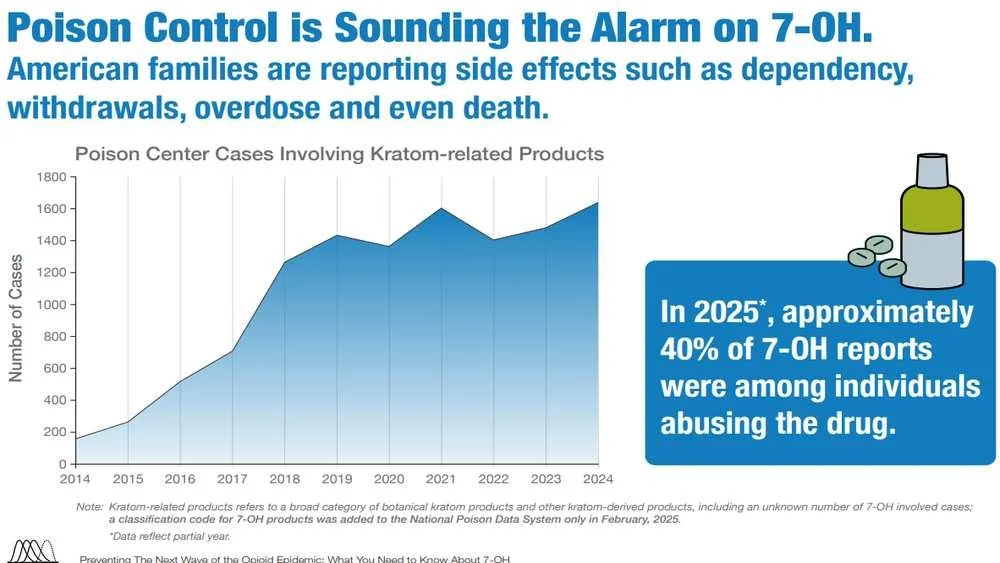
*image obtained from the FDA website regarding Poison Control data on Kratom
Common Side Effects of Kratom Use
Many of the side effects of Kratom usage mimic that of all other opioids. However, such effects all depend on amount, frequency, and other factors such as using concentrates like 7-OH.
Frequently Reported Short Term Side Effects
Data from U.S. poison control centers and clinical reports indicate that Kratom use is associated with a wide range of adverse effects, even at relatively low doses (Post et al., 2019). Commonly reported side effects include:
Cardiovascular and Neurological Effects
Tachycardia (rapid heart rate)
Hypertension (elevated blood pressure)
Drowsiness
Agitation
Irritability
Gastrointestinal and Physical Symptoms
Nausea and vomiting
Constipation
Loss of appetite
Muscle soreness
Runny nose
Itching
While some users initially experience stimulant-like effects at lower doses, higher doses often produce sedative and opioid-like effects, increasing risk for respiratory depression and impaired functioning. Remember from the Kratom Part 1 blog that the Kratom plant is related to the coffee plant, hence why at smaller more traditional doses it can have stimulant effects.
And 7-OH, users may experience greatly stronger withdrawal effects. More information on these withdrawal effects for the 7-OH synthetic concentrates is listed on the 7-OH Addiction Treatment page of Recover Clarity’s website. Here you will learn about how the use of Buprenorphine medications can greatly assist with 7-OH treatment and get a person fully free of 7-OH. It is important to also understand How Suboxone Works but do know that completing treatment is a goal here at Recover Clarity and getting people back to a life free of all substances.
Adverse Effects Associated with Chronic Kratom Use
Chronic or high dose Kratom use has been linked to more severe adverse outcomes. Serious medical and psychiatric complications can come from this usage including neurological, psychiatric, and hepatic complications documented in case series and clinical toxicology literature (Post et al., 2019). These effects often mirror complications seen with long term opioid use, despite Kratom not being classified as an opioid.
Documented Adverse Effects
Seizures
Tremors
Insomnia
Hallucinations
Hostility and aggression
Unintended weight loss
Anorexia
Liver toxicity and liver disease
Emerging evidence suggests Kratom induced liver injury may occur within weeks of use, particularly in individuals with underlying hepatic vulnerability or concurrent substance use.
Adverse effects can also be seen even worse in those who are using other substances at the same time as Kratom. This polysubstance effect can make it harder for researchers to fully pinpoint the negative effects of Kratom alone, but the concerns are still there.
Kratom Dependence and Withdrawal Symptoms

As with other opioids, Kratom and especially 7-OH can lead to dependence on the substance as well as withdrawal symptoms. These will all depend on dosage, duration of use, and frequency.
Physical and Psychological Dependence
Kratom is associated with both psychological cravings and physical dependence, with user surveys and pharmacological analyses demonstrating tolerance development and withdrawal symptoms consistent with substance use disorder criteria (Grundmann, 2017). Regular use can lead to tolerance, requiring increasingly larger doses to achieve the same effect, an established risk factor for addiction.
Withdrawal symptoms resemble those seen in opioid withdrawal and may include:
Common Withdrawal Effects
Diarrhea
Muscle aches and joint pain
Fever and chills
Emotional instability
Mood swings
Aggression or hostility
Loss of appetite
Irritability
Depressed mood
Although some proponents describe Kratom withdrawal as “milder” than opioid withdrawal, many individuals report significant distress that interferes with daily functioning, often leading to continued use to avoid symptoms.
For 7-OH, due to the severity of which this alkaloid binds to the mu-opioid receptors and the potency reaching up to 13 times more than morphine, the withdrawal effects can be severe. Often requiring MAT or MOUD treatment to assist with withdrawal and return a person back to a life without substances. Luckily, Completing Treatment is something possible and something we pride ourselves on at Recover Clarity. Many people inaccurately believe that completing Suboxone treatment is not feasible and is life-long.
Drug and Alcohol Interactions with Kratom
Central Nervous System (CNS) Depressant Effects
Kratom exerts central nervous system activity that can become dangerous when combined with other CNS active substances (polysubstance use). Documented interactions raise concern for additive and synergistic effects.
Additive vs. Synergistic Effects Explained
Additive effects occur when combined drug effects equal the sum of each drug individually (1 + 1 = 2).
Synergistic effects occur when combined effects exceed expectations (1 + 1 = 3 or more), dramatically increasing overdose risk.
This is especially true for substances that have similar effects on the same nervous system, such as opioids and benzodiazepines.
High Risk Substance Combinations
Kratom use alongside the following substances significantly increases risk:
Alcohol
Benzodiazepines
Opioids and opiates
Barbiturates
Antidepressants
Many Kratom related deaths involve polysubstance use, highlighting the danger of these interactions and the elevated overdose risk when Kratom is combined with other central nervous system depressants (Olsen et al., 2019).
Regulatory Status of Kratom
Federal Status in the United States
The status of this substance is constantly evolving. When I first wrote about Kratom for another blog over two years ago, many things have since changed. So, this information is current as of January 2026 when this blog is published. If you make a comment, I am happy to update information or reply if you have any questions.
At the federal level, Kratom remains legal but is classified by the Drug Enforcement Administration (DEA) as a “Drug and Chemical of Concern”. Kratom was first noticed as a concern in the United States 2016, with the DEA (2016) asking to place this as a scheduled substance. But it was forced to withdraw this request by Congress only a few months later. Then on January 22, 2025, the DEA (2025) was able to place this label back on Kratom. Since then, the U.S. FDA (2025b) has requested on July 29th, 2025, to have the 7-OH to be scheduled as a Schedule I Controlled Substance under the Controlled Substances Act.
The Food and Drug Administration (FDA) has not approved Kratom for any medical use and has issued multiple public warnings regarding its safety.
Individual State Legality of Kratom
Writing on all state laws is a challenging task and outside the scope of this blog post. If you have concerns about the legality of Kratom, you should check your local town, county, and state laws. Or even better, just avoid Kratom and 7-OH all together. The following information was obtained from the Legislative Analysis and Public Policy Association (LAPPA), which is a nonprofit organization that conducts legislative research and pays special attention to laws around substance use disorders (LAPPA, 2025). The data was current through early 2025, but a few late 2025 changes have been updated. As with a lot of legislation, some of these are not clear cut on the status of the substance.
Kratom legality varies widely by state and municipality. Some states have rather strict bans or regulations while others have an absence of any regulation. And many states have legislation that has been proposed and are still waiting for decisions to be implemented, such as the state of Pennsylvania.
The following is a light overview of the legal status of Kratom and 7-OH.
States Where Kratom is Banned as a Schedule I Controlled Substance
A Schedule I Controlled Substance is the highest scheduling for a substance or chemical. This level of scheduling indicates that there is no currently accepted medical use for the substance or chemical and it poses a high potential for abuse (DEA, n.d.). With this scheduling it comes with the highest degree of criminal conviction for possession and distribution of the substance or chemical. As Suboxone Treatment is a great option for those requiring medical treatment, Suboxone is only a Schedule III substance.
The following are the states that have made Kratom (Mitragynine) and/or 7-OH (7-Hydroxymitrgynine) Schedule I Controlled Substances (LAPPA, 2025).
Alabama – Both Kratom( Mitragynine) and/or 7-OH (7-Hydroxymitrgynin) added as Schedule I on May 10, 2016
Arkansas - Both Kratom( Mitragynine) and/or 7-OH (7-Hydroxymitrgynin) added as Schedule I on November 8, 2015
Indiana – Mitragynine and 7-OH added to the definition of a synthetic drug on July 1, 2012. Under Indiana Code, all synthetic drugs are Schedule I controlled substances.
Vermont – Placed both Kratom and 7-OH as a Regulated Drug Rule on January 1, 2016. This makes the substances illegal unless prescribed and dispensed by a professional that is licensed to do so.
Wisconsin – On April 25, 2014, placed Kratom-related substances to their list of Schedule I controlled Substances.
States Reversing Previous Bans

Rhode Island had originally made Kratom and 7-OH Schedule I Controlled Substances back in 2017. Since then, some lawmakers have been trying to reverse this ban, with success in 2025 with the passing of The Rhode Island Kratom Act (H5565), thus reversing this scheduling of the substance and allowing the sale of Kratom starting April 1, 2026 (Castro, 2025).
This is a good example of why doing more localized research is important as this change to the law is not accurately reported by LAPPA (2025), which is understood as laws are frequently changing, especially pertaining to Kratom and 7-OH.
States with Regulations or Restrictions
When it comes to states with varying degrees of regulations and restrictions, it can be vastly different. Some have rules on sales to minors, while others require people to be 18 or 21 and older. Some have specific regulations on the amount of 7-OH that can be in the product, often requiring it to be 2% or less. Restrictions on synthetically manufactured versions of Kratom are seen as well.
Arizona
Colorado
Florida
Georgia
Kentucky
Louisiana
Maryland
New York
Nevada
Oklahoma
Ohio
Oregon
South Carolina
South Dakota
Tennessee
Texas
Utah
Virginia
West Virginia
Here at Recover Clarity, we provide treatment to individuals suffering from Kratom and 7-OH addiction all across the state of West Virginia, including the areas of Wheeling and the Northern Panhandle, Beckley, Charleston, Morgantown, Huntington, and any other part of the state.
States with NO Specific Laws Identified

Fictional illustration highlighting public health concerns when Kratom is sold without clear state legislation or age-restriction requirements. The image is intended to emphasize the risks associated with unrestricted access and the importance of establishing minimum age limits for Kratom and/or 7-OH purchases.
The following states at the time of the information composed by LAPPA (2025) had no specific laws or regulations in place. But many do have legislation in the works.
Alaska
California
Connecticut
Delaware
Hawaii
Idaho
Illinois
Iowa
Kansas
Maine
Massachusetts
Michigan
Minnesota
Mississippi
Missouri
Montana
Nebraska
New Hampshire
New Jersey
New Mexico
North Carolina
North Dakota
Pennsylvania
Washington
Wyoming
At Recover Clarity we assist people with treatment for 7-OH and Kratom addiction across the state of Pennsylvania, from the Pittsburgh Area all the way to Philadelphia.
County and City Level Laws
Just because a state may not have legislation regulating or banning Kratom and/or 7-OH does not mean that an individual county or city could have such legislation in place. A comprehensive list at this level would require hundreds to thousands of hours of research and could be frequently changing. Again, the best way to not worry about the laws is to simply avoid Kratom and 7-OH all together.
An example of this level of would be Riverside County in California. At the state level there are no current regulations on Kratom or 7-OH (LAPPA, 2025). However, on November 27, 2025, Riverside County placed regulations on these substances. The possession, distribution, or sale of 7-OH or Kratom products with more than 2% 7-OH concentration is prohibited (Ramirez, 2025). There are also rules that no one under the age of 21 can buy these substances, ID verification is required, and businesses are not to use any packaging that would be deemed to be attractive to children.
States such as California, Colorado, Florida, Illinois, and Mississippi all allow local jurisdictions to impose such bans. And other states such as Oregon, Tennessee, New Hampshire, and West Virginia have age restrictions.
International Legal Landscape
At least 28 countries have banned Kratom entirely due to concerns over abuse potential, psychoactive effects, and addiction risk. Many Southeast Asian and European countries prohibit its possession and use, including but not limited to, Singapore, Malaysia, United Kingdom, Italy, France, Portugal, among others. Other countries have other restrictions, such as Canda, which has deemed Kratom not suitable and allowed for human consumption.
Like that of the laws across the United States, this list of legislation is ever changing, but for the purpose of this blog is used to provide some framework and is current as of the publication of the blog.
Southeast Asia Legality
When looking at the legality of a plant or substance with a long historical and cultural use, looking at the legislation in the native region can speak volumes. Of the three countries the Kratom plant is native, Thailand, Malaysia, and Indonesia, there is legislation on the substance. Some of this legislation dates back to 1943 when World War II was going on, therefore showing the concerns with Kratom for over 80 years.

Fictional illustration representing early concerns about Kratom use in Thailand during the World War II era.
Most notably is Thailand, where Kratom has a historical cultural use, re-legalized it in 2021. Kratom was originally criminalized in Thailand in 1943 (Charoenratana et al., 2021). As the legalization of Kratom has come about, special consideration for alteration of this in Thailand, usually called 4x100 are still illegal. There is no specific mentioning of 7-OH in Thailand, but then either are any mentions of them concentrating this alkaloid. The legalization is for the traditional usage of fresh leaves, a usage which is not possible in the United States. Thailand also has strict controls, including limits on the use to anyone under the age of 18, and women that are either pregnant or breastfeeding.
Malaysia listed Mitragynine as a scheduled poison in 2003 (Khalil et al., 2000). Indonesia which is the largest exporter of Kratom and the legislation on Kratom in this country is less clear. And current legislation that is in effect is not very well enforced. Kratom in 2017 was supposed to be enforced as a controlled substance with a five-year period to implement such enforcement (Kadir & Ramadhan, 2025). However, this still has not been fully enforced.
The Kratom Consumer Protection Act (KCPA)
Purpose and Ongoing Debate
The Kratom Consumer Protection Act (KCPA) has been enacted in states including Georgia, Nevada, Oklahoma, Utah, and West Virginia, with a current 13 states in total having such legislation passed. There are some key provisions of the KCPA that are typical across states, but still each state will have some variations (Library of Congress, n.d.).
Key Provisions
1. Product Definition and Legal Status
This is set to define what qualifies as a legal Kratom product and can preempt local bans below the state level to prevent conflicting regulations.
2. Purity and Testing Standards
This is to require laboratory testing to confirm that the products are free from contaminants as well as accurately reflect their contents, which include alkaloid levels.
3. Labeling and Transparency
This is to mandate accurate labeling which can include:
Manufacturer information
Ingredients
Alkaloid content
Health and safety warnings (if applicable)
4. Age Restrictions
This is set to prevent the sale to minors, but states will vary on this, often with the age limit being 18 or 21 years of age.
5. Registration and Compliance
Some states are requiring manufacturers and/or vendors to register with a state agency, such as in West Virginia.
6. Enforcement and Penalties
This again will vary greatly between states but is set to include fines or sanctions for non-compliance with the regulations.
Criticisms of the KCPA
There are many criticisms about the Federal Kratom Consumer Protection Act.
1. KCPA Favors Industry Over Consumer
A common criticism is that the KCPA is not set to actually protect consumers. In a blog by MCT Law they make a good point in that the Federal Bill S.3039, the word “consumer” is only ever used in the title (Cowgill, 2023). This shows potential that this bill is more geared to protect the industries manufacturing and distributing Kratom over that of public health.
2. Public Health Concerns
Many researchers as well as the FDA have expressed concerns over the safety of Kratom. Crocker (2025) mentions that the Kratom Consumer Protection Act (KCPA) may not adequately address the health risks as their main focus is on labeling and age limits and not risks of consumption and dosage. The data on the safety of Kratom in general is still limited at this point with more research being needed.
3. Regulatory Inconsistency for Protection
As the laws under the KCPA vary between states, this leaves a patchwork of regulatory approaches. This can cause uneven levels of protection depending on where the consumers live. And changing regulations can cause hazardous products to still circulate despite having laws to protect consumers. Why a federal level intervention would be more appropriate than only at the state level.
4. Lack of Federal Oversight
The KCPA is only at the state level, leaving out federal regulatory authority to standardize safety and other concerns with the substance.
Blog Author’s Conclusion and Other Concerns
This is the opinion of the author of this blog concerning the safety of Kratom. First, I have been researching Kratom for many years and writing on this topic for roughly three years. Reviewing current legal frameworks, both domestic and international, as well as reading peer reviewed scientific research on the substance and the alkaloids. First, I do want to note that there are definitely possible benefits of traditional and limited use of Kratom. So anyone thinking I am not acknowledging this medicinal value, please read the information again.
Naturally occurring in Kratom is the 7-OH alkaloid, which research is clearly showing to have grave concern for physical dependency and abuse potential. Even though this only makes up to 2% of the alkaloid structure of Kratom, even in the most natural form of the substance this dangerous part is still present. Therefore, having any Kratom legally allowed still allows this dangerous alkaloid to be bought legally in the United States (outside of the 5 states previously mentioned).
Through talking with patients and others in the field of addiction treatment, one this is clear, making high concentrations of Kratom at home is 100% possible. Talking with some individuals, they have started learning about and making Kratom concentrations going back over a decade. And the process appears to be rather simple and easily done in a regular residential kitchen. Even with two individuals reporting their at-home concoctions being stronger than the heroin they were consuming at that time.
Knowing the dangers that are at hand, in this author’s opinion, having any legal Kratom possesses great dangers to society. Which is a sad state for a substance that could have some medicinal benefits for people, but is the potential for abuse and the possible start of another opioid crisis worth the risk?
The question then… this a balance of individual choice and public safety. Legislation aimed more at protecting the industry than the consumer is a concern with some of the proposed consumer protections. Should protections like that on Pseudoephedrine have been instituted? Well think on this… even with those protections, Methamphetamines are still being made using this controlled substance. How would we not see the same happen for Kratom.
It is this author’s opinion that legal Kratom will not stop high concentrations and extractions of 7-OH, which clearly are posing a threat of another opioid crisis in the United States. Being someone that has lost many loved ones to opioids, this is a scary place to see the potential for loss of life. And with this being an “all natural” product, and the labeling as such, this is potentially reaching people who under normal circumstances would never have an addiction to opioids.
References
Castro, A. (2025, May 29). Kratom Regulation Bill Clears Rhode Island House. Rhode Island Current. https://rhodeislandcurrent.com/2025/05/29/kratom-regulation-bill-clears-rhode-island-house/
Charoenratana, S., Anukul, C., & Aramrattana, A. (2021). Attitudes towards Kratom use, decriminalization and the development of a community-based Kratom control mechanism in Southern Thailand. International Journal of Drug Policy, 95. https://doi.org/10.1016/j.drugpo.2021.103197
Cowgill, M. (2023, December 12). The Kratom Consumer Protection Act does not protect consumers. mctlaw. https://www.mctlaw.com/product-liability/kratom-lawsuits/kratom-consumer-act-letter-to-congress-members/
Crocker, S. (2025). Public health researcher warns of the drug kratom’s dangers and advocates for legislation. University of North Texas Health Science Center. Retrieved from https://www.unthsc.edu/newsroom/story/public-health-researcher-warns-of-the-drug-kratoms-dangers-and-advocates-for-legislation/
Drug Enforcement Administration. (n.d.). Drug scheduling. Drug Enforcement Administration. https://www.dea.gov/drug-information/drug-scheduling#:~:text=Schedule%20I%20drugs%2C%20substances%2C%20or,)%2C%20methaqualone%2C%20and%20peyote.
Drug Enforcement Administration. (2016, August 30). DEA Announces Intent To Schedule Kratom. https://www.dea.gov/press-releases/2016/08/30/dea-announces-intent-schedule-kratom
Drug Enforcement Administration. (2020). Drugs of concern: Kratom. https://www.deadiversion.usdoj.gov
Drug Enforcement Administration. (2025, January 22). Kratom [Drugs of Concern]. U.S. Department of Justice. https://www.dea.gov/taxonomy/term/311
Grundmann, O. (2017). Patterns of kratom use and health impact in the US—Results from an online survey. Drug and Alcohol Dependence, 176, 63–70. https://doi.org/10.1016/j.drugalcdep.2017.03.007
Kadir, A. & Ramadhan, M. R. (2025). The urgency of categorizing Kratom plants into class I narcotics according to law number 35 of 2009 concerning narcotics. International Journal of Accounting, Management, Economics and Social Sciences (IJAMESC), 3(2), 673–682. https://doi.org/10.61990/ijamesc.v3i2.477
Khalil, S., Halim, R. A., & Abdullah, J. S. A. (2000). Enforcement status of the Poisons Act 1952 against offences related to kratom (Mitragyna speciosa Korth.) misuse in Malaysia. UUM Journal of Legal Studies, 11(1), 75-93. https://doi.org/10.32890/ uumjls.11.1.2020.6928
Legislative Analysis and Public Policy Association. (2025). Kratom: Summary of State Laws. https://legislativeanalysis.org/wp-content/uploads/2025/07/Kratom-Summary-of-State-Laws.pdf
Library of Congress. (n.d.). Kratom Regulation: Federal status and state approaches. https://www.congress.gov/crs-product/LSB11082
Olsen, E. O. M., O’Donnell, J., Mattson, C. L., Schier, J. G., & Wilson, N. (2019). Notes from the field: Unintentional drug overdose deaths with kratom detected—27 states, July 2016–December 2017. Morbidity and Mortality Weekly Report, 68(14), 326–327. https://doi.org/10.15585/mmwr.mm6814a2
Post, S., Spiller, H. A., Chounthirath, T., & Smith, G. A. (2019). Kratom exposures reported to United States poison control centers: 2011–2017. Clinical Toxicology, 57(10), 847–854. https://doi.org/10.1080/15563650.2019.1569236
Ramirez, A. (2025, November 12). Supervisors adopt ordinance regulating sale, distribution of Kratom. The Riverside Record. https://riversiderecord.org/supervisors-adopt-ordinance-regulating-sale-distribution-of-kratom
U.S. Food and Drug Administration. (2018). FDA and kratom. https://www.fda.gov
U.S. Food and Drug Administration. (2025a, July 29). 7-hydroxymitragynine (7-OH): An assessment of the scientific data and toxicological concerns around an emerging opioid threat [PDF]. https://www.fda.gov/files/drugs/published/7-hydroxymitragynin_7-oh_an_assessment_of_the_scientific_data_and_toxicological_concerns_around_an_emerging_opioid_threat.pdf
U.S. Food and Drug Administration. (2025b, July 29). FDA and kratom. https://www.fda.gov
U.S. Food and Drug Administration. (2025c). Preventing the next wave of the opioid epidemic: What you need to know about. https://www.fda.gov/media/187900/download