

Cat’s Claw, Corynoxine, MGM-15, and 7-OH: What Is Really in the New “Cat’s Claw” Products?
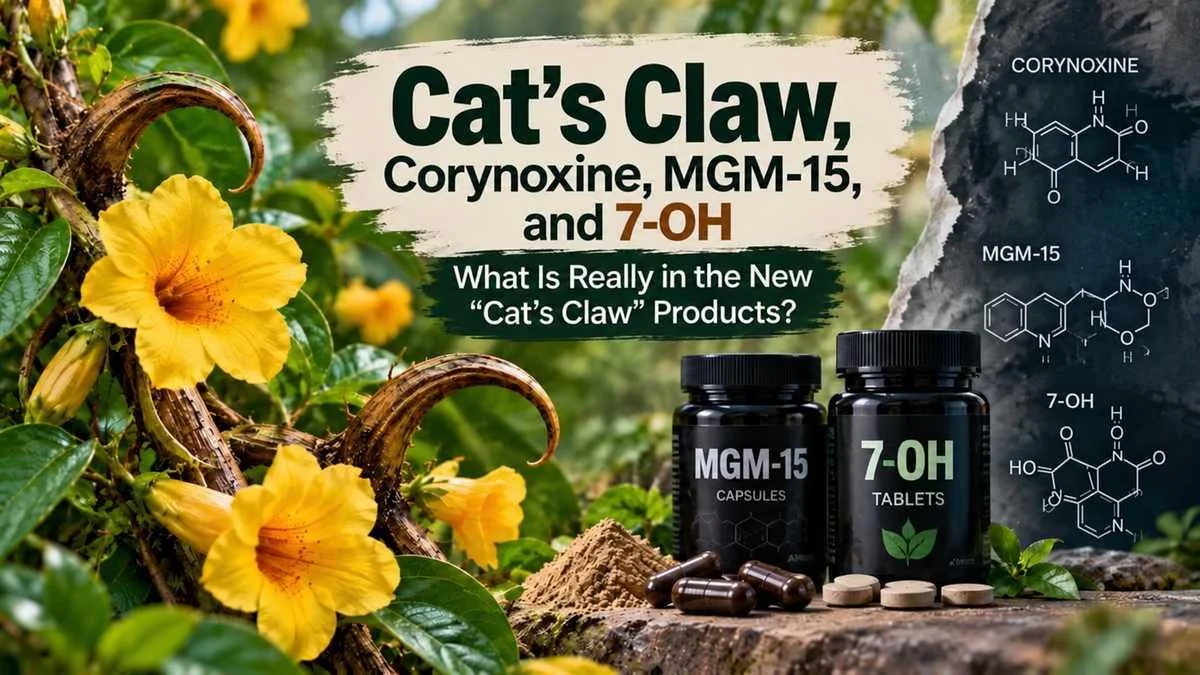
There is a much more interesting, and potentially concerning, story here than simply saying, “Cat’s Claw is the next 7-OH”. And how can a plant with a long history of non-complicated use and beautiful flowers now potentially be a plant of concern.
Cat’s Claw is a real plant with a long history of traditional use. It also naturally contains alkaloids, including corynoxine and corynoxine B, that researchers have demonstrated can interact with opioid receptors.
At the same time, products labeled and marketed as “Cat’s Claw” have recently appeared in smoke shops and online retailers, sometimes positioned as alternatives to kratom or 7-hydroxymitragynine (7-OH).
Those are not necessarily the same thing.
In fact, laboratory testing of at least some products marketed as Cat’s Claw has identified MGM-15 and mitragynine pseudoindoxyl, potent opioid-active compounds associated with the rapidly changing kratom-derived drug market, rather than simply concentrated Cat’s Claw alkaloids. Utah officials connected Buzzers-brand Cat’s Claw tablets containing these substances with several severe health incidents and an investigation involving a death (Utah Department of Agriculture and Food, 2026).
This development is especially important because concentrated 7-OH products have already resulted in dependence and withdrawal for some consumers. Recover Clarity has previously discussed these concerns in greater depth on its 7-OH addiction treatment page.
The most important point may be this:
“Cat’s Claw” is not one new drug.
We may be looking at three very different categories being placed under the same general name:
Traditional Uncaria tomentosa products
Extracted or highly concentrated alkaloids such as corynoxine
Retail products using Cat’s Claw branding while containing entirely different or additional opioid-active compounds
Understanding those differences may tell us something important about where the post-7-OH market could be heading.
What Is Cat’s Claw?
Cat’s Claw, commonly called uña de gato, generally refers to Uncaria tomentosa or Uncaria guianensis. These woody vines are native to tropical regions of Central and South America, including the Amazon rainforest.
Cat’s Claw has a history of traditional medicinal use, and modern supplements are promoted for conditions ranging from inflammation and arthritis to immune support. However, traditional use and modern supplement marketing should not be confused with established clinical effectiveness.
The National Center for Complementary and Integrative Health states that very few high-quality human trials have been conducted and that there is not conclusive evidence supporting Cat’s Claw for any specific health purpose (National Center for Complementary and Integrative Health [NCCIH], n.d.).
Chemically, however, the plant is interesting.
Uncaria tomentosa contains a variety of indole and oxindole alkaloids. Among them are corynoxine and corynoxine B.
Those compounds are one reason Cat’s Claw deserves closer attention as manufacturers search for new psychoactive products.
Why Does Corynoxine Matter?
Corynoxine is particularly interesting because research indicates that it interacts with the mu-opioid receptor.
This is the same broad receptor system involved with substances including morphine, fentanyl, buprenorphine, 7-OH, and numerous other opioids. That does not mean these substances are equally potent or equally dangerous. It means they can interact with the same biological receptor system.
A 2021 study examining oxindole alkaloids reported that corynoxine had measurable binding affinity at the mu-opioid receptor. In a rat hot-plate experiment, corynoxine also produced antinociceptive effects that were reversed by naltrexone, providing additional evidence that opioid receptors were involved (Chear et al., 2021).
An important clarification is that this particular pharmacology study isolated corynoxine from Mitragyna speciosa, or kratom—not Cat’s Claw. Corynoxine, however, has also been identified and isolated from Uncaria tomentosa.
The molecular compound, rather than the name of the plant it came from, is what interacts with the receptor.
More recent research has been added to the picture. A 2026 study evaluating numerous kratom alkaloids at human opioid receptors found that corynoxine A demonstrated strong affinity for the human mu-opioid receptor. Corynoxine B demonstrated weaker binding, but both compounds demonstrated opioid-receptor activity in laboratory testing (Hemby et al., 2026).
These laboratory findings should not be interpreted as a simple potency comparison with drugs such as morphine, fentanyl, or 7-OH. Different experimental methods cannot necessarily be compared directly.
They do establish an important point:
Corynoxine is pharmacologically active at opioid receptors.
What remains largely unknown is what happens when humans consume purified or highly concentrated corynoxine.
Can Corynoxine Be Extracted and Concentrated From Cat’s Claw?
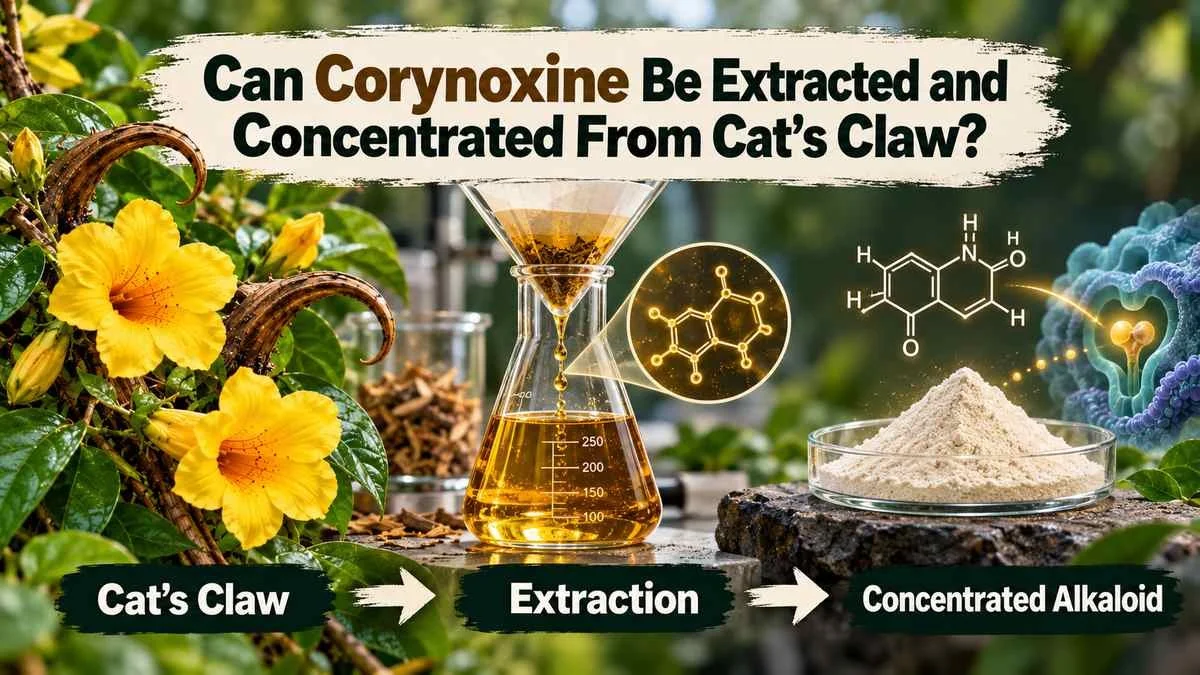
Yes.
And this is where the history of the kratom market becomes particularly relevant.
A 2015 laboratory study demonstrated that researchers could take Uncaria tomentosa plant material and isolate corynoxine and corynoxine B through extraction and chromatography. Starting with plant material, researchers successfully produced highly purified isolated compounds (Zhang et al., 2015).
That does not establish that commercial Cat’s Claw products are currently being manufactured this way.
It establishes that the chemistry is possible.
Why the Kratom Market Provides an Important Comparison
We have already watched a similar progression occur with kratom.
Traditional kratom leaf contains numerous naturally occurring alkaloids. The U.S. marketplace eventually moved far beyond traditional leaf into increasingly concentrated extracts, enhanced products, isolated or manufactured 7-OH, and later derivatives such as MGM-15.
For a deeper explanation of how traditional kratom differs from the newer high-potency products, see Kratom Part 1: What It Is, How It Works, and Potency Differences.
Once a psychoactive molecule is identified within a plant, manufacturers are no longer necessarily limited to the concentration naturally occurring in that plant.
A compound can potentially be extracted.
It can be purified.
It can be concentrated.
Related molecules can potentially be chemically modified.
The resulting product may still use the name of a familiar plant even though its pharmacology no longer resembles traditional consumption of that plant.
Are the New “Cat’s Claw” Products Actually Concentrated Cat’s Claw?
This is probably the most important distinction in the entire discussion.
We currently do not have evidence demonstrating that the effects reported from recent smoke-shop Cat’s Claw products are simply the result of manufacturers extracting enormous amounts of natural corynoxine from Uncaria tomentosa.
In at least one significant investigation, laboratory testing pointed somewhere else entirely.
In July 2026, the Utah Department of Agriculture and Food and Utah Poison Control Center warned consumers about Buzzers-brand Cat’s Claw tablets following severe health incidents.
Officials reported that tested tablets contained MGM-15 and mitragynine pseudoindoxyl (Utah Department of Agriculture and Food, 2026; Utah Poison Control Center, 2026).
That means a consumer may believe they are purchasing a completely different botanical substance when the actual psychoactive ingredients may be connected to the same rapidly evolving class of kratom-related opioid compounds they were attempting to avoid.
That is a very different issue from traditional Cat’s Claw.
Why Product Labeling Matters
The name printed on the front of a package cannot necessarily tell someone what pharmacologically active substances are inside it.
This issue has already become increasingly complicated with products marketed as kratom, 7-OH, enhanced kratom, MGM-15, and related substances.
The same problem becomes even more difficult when a completely different botanical name is used.
A person seeing “Cat’s Claw” may reasonably assume that the product consists primarily of Uncaria tomentosa.
Testing of some recent products demonstrates why that assumption may not always be safe.
Where Does MGM-15 Fit Into This?
MGM-15 is a synthetic opioid-related compound derived from the chemistry surrounding 7-hydroxymitragynine.
A 2025 study analyzing commercially available MGM-15 tablets found approximately 10.9 mg of MGM-15 per tablet. Researchers also found that MGM-15 displayed greater binding affinity at human mu- and delta-opioid receptors than 7-OH under their experimental conditions. The researchers emphasized that MGM-15 had not been adequately studied in humans (Gour et al., 2025).
MGM-15 entered the commercial marketplace surprisingly quickly.
By 2026, federal regulators were responding not only to 7-OH but also MGM-15, MGM-16, and mitragynine pseudoindoxyl.
Because these regulations and product formulations are changing quickly, Recover Clarity maintains a separate page covering current 7-OH, MGM-15, and kratom legal and product changes.
This history matters because banning or restricting one compound does not necessarily make consumer demand disappear.
Instead, manufacturers may search for another molecule, formulation, product name, or legal category.
That is part of what makes the appearance of Cat’s Claw-branded psychoactive products worth watching.
Is Cat’s Claw Becoming the Replacement for 7-OH?
Possibly, but that question needs to be phrased carefully.
Traditional Cat’s Claw itself did not suddenly become a new synthetic opioid.
The plant has existed for centuries.
Corynoxine did not suddenly appear in 2026 either. Scientists have known that Uncaria species contain corynoxine, and researchers demonstrated years ago that these compounds could be isolated and purified.
What appears to be changing is the commercial drug market surrounding the Cat’s Claw name.
Products are appearing in some of the same retail environments that previously sold concentrated kratom and 7-OH products. Some are marketed as powerful alternatives.
And in at least some tested products, the primary concern has not been natural Cat’s Claw chemistry at all. It has been the presence of other potent opioid-active substances.
This creates two separate concerns.
First, we need to understand what could happen if manufacturers begin isolating, concentrating, or modifying naturally occurring Cat’s Claw alkaloids such as corynoxine.
Second, we need to understand what may already be happening when the name of one botanical is used to market a product containing other psychoactive compounds.
Those are related concerns, but they are not the same issue.
What Do We Still Not Know About Corynoxine?
A great deal.
There is extremely limited human research on purified corynoxine.
We do not have adequate clinical studies defining it:
Pharmacokinetics in humans
Dependence liability
Withdrawal syndrome
Respiratory effects
Overdose risk
Safe dosage range
Effects at very high concentrations
Interactions with alcohol, benzodiazepines, opioids, or other medications
The receptor research tells us that corynoxine deserves additional investigation.
It does not demonstrate that taking an ordinary Cat’s Claw supplement produces effects comparable to taking morphine, 7-OH, MGM-15, or another concentrated opioid agonist.
Those are very different questions.
Likewise, a tablet labeled “Cat’s Claw” should not automatically be assumed to contain concentrated corynoxine.
Recent testing demonstrates precisely why the ingredients need to be considered separately from the branding.
The Bigger Lesson from Kratom and 7-OH
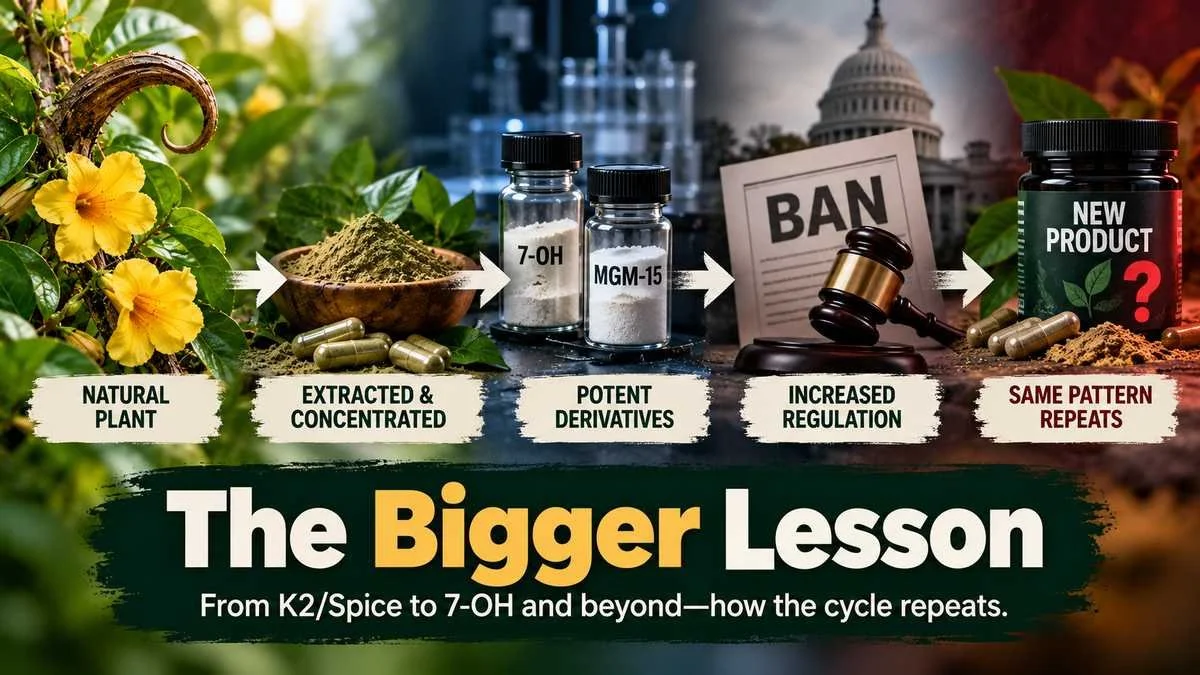
The evolution of the kratom market has taught us an important lesson:
The name of the plant on a package does not necessarily tell us what type of drug exposure a person is receiving.
Traditional kratom leaf, concentrated kratom extracts, enhanced 7-OH products, MGM-15, and mitragynine pseudoindoxyl may all be discussed under the broad umbrella of “kratom,” despite significant differences in chemistry, concentration, and pharmacology.
Cat’s Claw may now be entering a similar conversation.
That does not mean an ancient medicinal plant should be labeled as a newly invented dangerous drug.
It means consumers, clinicians, and families should become much more cautious about assuming that a commercial product is equivalent to the plant pictured or named on its packaging.
The name on the package may be becoming less informative than the chemistry inside the tablet.
What If Someone Is Already Dependent on These Products?
The emergence of new product names can make it especially difficult for people to recognize what they are experiencing.
Someone may believe they are taking a legal herbal supplement and then begin noticing that they need increasingly frequent doses, feel sick when they stop, wake during the night needing another dose, or repeatedly attempt to quit without success.
Those symptoms matter more clinically than the marketing name printed on the package.
People experiencing problems specifically with kratom or concentrated kratom products can learn more about available kratom addiction treatment.
For individuals using 7-OH, MGM-15, Cat’s Claw-branded products, or another emerging substance, it can also be helpful to bring the actual packaging or a photograph of the label to a healthcare provider. With rapidly changing products, knowing the exact product name and listed ingredients can be clinically important.
Treatment in Pennsylvania
For Pennsylvania residents experiencing dependence, withdrawal, or difficulty stopping an opioid-active product, Recover Clarity provides outpatient treatment and telehealth options throughout Pennsylvania. More information about treatment availability is available on the Pennsylvania Suboxone treatment page.
Not everyone who has used Cat’s Claw, kratom, or another product needs medication treatment. Treatment decisions should be based on the actual substance being used, frequency and amount of use, withdrawal symptoms, medical history, and the individual circumstances of the person seeking help.
Final Thoughts: Ask What Is Actually in the Product
For clinicians, patients, families, and people recovering from opioid use disorder, the emergence of these products creates a relatively simple but increasingly important question.
A product marketed as “natural,” “herbal,” “kratom-free,” or “7-OH-free” should not automatically be assumed to lack opioid activity.
Instead of asking only:
“What plant does the label say this came from?”
We may increasingly need to ask:
“What compounds are actually in it?”
As manufacturers develop new extracts, derivatives, and product formulations, independent laboratory testing and continued research will become increasingly important.
Cat’s Claw itself is not a newly invented opioid.
But corynoxine is an opioid-receptor-active alkaloid worthy of additional study, and recent Cat’s Claw-branded retail products demonstrate how quickly the commercial psychoactive-drug market can adopt a familiar botanical name for something substantially more complicated.
That distinction is important—and it is likely to become even more important as this market continues to evolve.
References
Chear, N. J.-Y., León, F., Sharma, A., Kanumuri, S. R. R., Zwolinski, G., Abboud, K. A., Singh, D., Restrepo, L. F., Patel, A., Hiranita, T., Ramanathan, S., Hampson, A. J., McMahon, L. R., & McCurdy, C. R. (2021). Exploring the chemistry of alkaloids from Malaysian Mitragyna speciosa (kratom) and the role of oxindoles on human opioid receptors. Journal of Natural Products, 84(4), 1034–1043.
Drug Enforcement Administration. (2026). Schedules of controlled substances: Temporary placement of mitragynine pseudoindoxyl, MGM-15, and MGM-16 in Schedule I. Federal Register, 91, 54948–54956.
Gour, A., Mukhopadhyay, S., Henderson, A., Awad, A., Seabra, M. A., Pullman, M., León, F., Cutler, S. J., McCurdy, C. R., & Sharma, A. (2025). From kratom to semi-synthetic opioids: The rise and risks of MGM-15. Drug Testing and Analysis, 17(12), 2384–2389.
Hemby, S. E., Rangel-Grimaldo, M., McIntosh, S., Zheng, J., Flores-Bocanegra, L., Graf, T. N., Coover, R. A., & Oberlies, N. H. (2026). Multifaceted modulation of human opioid receptors by kratom alkaloids: Binding affinity, functional selectivity, and allosteric activity. Frontiers in Pharmacology, 17, 1763551.
National Center for Complementary and Integrative Health. (n.d.). Cat’s claw: Usefulness and safety.
Utah Department of Agriculture and Food. (2026, July 30). Illegal kratom product sold in Utah County linked to death in Utah.
Utah Poison Control Center. (2026, July 22). Adulterated Cat’s Claw and Kava products may cause opioid overdose.
Zhang, Y., Liu, C., Qi, Y., Li, S., Pan, Y., & Li, Y. (2015). Circulating ultrasound-assisted extraction, countercurrent chromatography, and liquid chromatography for the simultaneous extraction, isolation, and analysis of the constituents of Uncaria tomentosa*. *Journal of Chromatography A, 1388, 36–42.