

From K2 and Spice to 7-OH: What History Can Teach Us About the Next Generation of Emerging Drugs
The Important Question May Not Only Be What Gets Banned—but What Comes Next
Drug markets have a long history of adapting to change.
A substance becomes popular. It may initially be legal, poorly regulated, or simply too new for existing laws to address. As reports of dependence, poisonings, emergency-room visits, or other harms begin to accumulate, regulators respond. Restrictions are imposed, products disappear from legitimate retailers, and manufacturers and consumers adjust.
Sometimes use drops dramatically.
Sometimes people stop using the substance altogether.
But sometimes the market changes the chemistry of the substance.
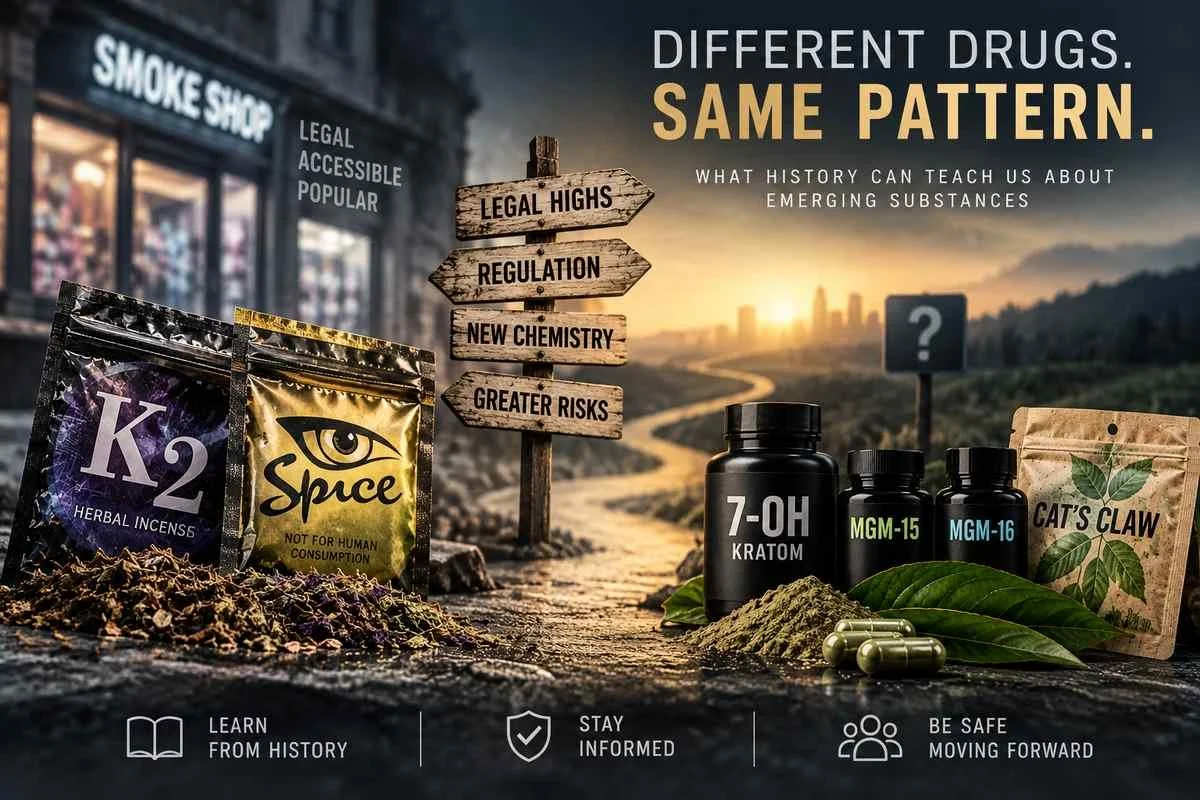
That is what happened with the synthetic cannabinoids commonly known as K2 and Spice. Their history is worth revisiting as the United States confronts another rapidly changing group of substances involving 7-hydroxymitragynine, commonly called 7-OH, MGM-15, MGM-16, mitragynine pseudoindoxyl, and even products being marketed under names such as “Cat’s Claw.”
This article is not an argument for or against banning these substances. Some of these emerging compounds present significant public health concerns, and federal regulators have already acted against several of them.
Instead, this is about learning from history.
When laws change the availability of a psychoactive product, clinicians, consumers, treatment providers, families, first responders, and public-health organizations should also watch for changes in the marketplace surrounding it.
The history of K2 and Spice teaches us an important lesson:
Removing one chemical does not necessarily remove the demand that developed around its effects.
Understanding what may come next is therefore just as important as understanding the substance being regulated today.
K2 and Spice Started as “Legal Highs”
K2 and Spice are sometimes discussed as though K2 existed first and later became Spice after prohibition. That is not quite what happened.
“Spice” became a prominent product name in Europe, while “K2” became one of the better-known names in the United States. Over time, both became broad terms describing a much larger category of synthetic cannabinoid products.
The early products often looked relatively harmless. Packages contained dried herbal material and were frequently marketed as “herbal incense” or labeled “not for human consumption.” They were sold openly through head shops, smoke shops, convenience stores, and online retailers.
But the herbs themselves were largely a delivery system.
The plant material had been treated with laboratory-created chemicals capable of activating cannabinoid receptors. Early examples included substances such as JWH-018, JWH-073, and CP-47,497. Several of these compounds had roots in legitimate scientific cannabinoid research before making their way into recreational products (Gunderson et al., 2012).
These substances were also not simply artificial marijuana.
THC is a partial agonist at cannabinoid CB1 receptors. Many synthetic cannabinoids behave as powerful full agonists, which can produce substantially different pharmacological effects and toxicities (Worob & Wenthur, 2020).
Yet to consumers, these products could appear very different from an illicit street drug.
They were colorful.
They were packaged.
They were sitting on store shelves.
And they were legal—or at least not yet specifically prohibited.
That retail environment created an assumption that still matters today:
If something can be purchased openly, some consumers assume it must have been evaluated for safety.
K2 demonstrated why that assumption can be dangerous.
Then Regulation Changed the Market
As poisonings and adverse events increased, states and the federal government began responding.
On March 1, 2011, the Drug Enforcement Administration temporarily placed five widely encountered synthetic cannabinoids, including JWH-018 and JWH-073, into Schedule I (U.S. Drug Enforcement Administration [DEA], 2011).
More compounds were subsequently controlled.
One might expect K2 and Spice simply to disappear.
Instead, the chemistry started changing.
Researchers subsequently documented multiple generations of synthetic cannabinoids. As particular compounds were identified and restricted, structurally different chemicals appeared while maintaining activity at cannabinoid receptors (Worob & Wenthur, 2020).
Early compounds were followed by substances such as UR-144, XLR-11, PB-22, AB-FUBINACA, ADB-PINACA, and numerous others.
Eventually, saying someone had consumed “K2” or “Spice” told a physician surprisingly little about the actual chemical they had consumed.
The name remained.
The drug underneath the name changed.
That transition is particularly important when we consider the rapidly changing market involving 7-OH and related kratom-derived products.
Did Banning K2 Cause More People to Use It?
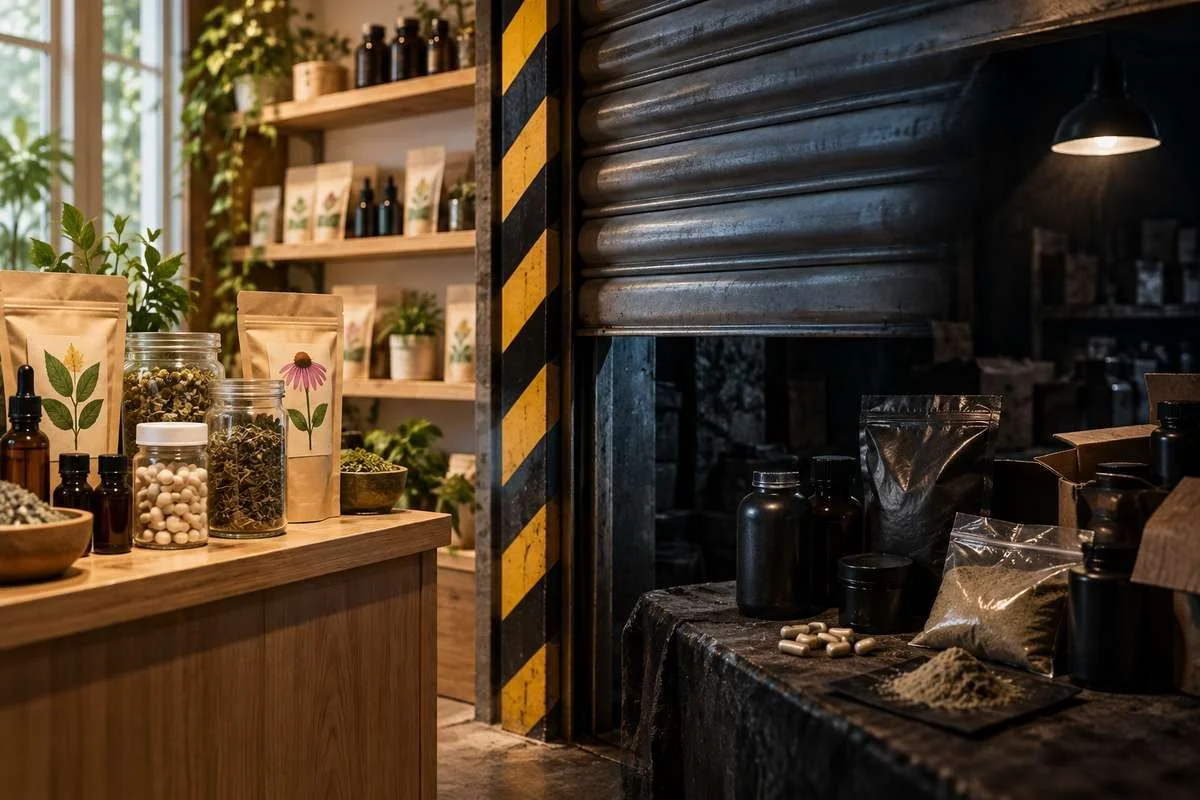
This is where we need to be careful.
The historical data does not support the simplistic conclusion that banning K2 caused more people to use synthetic cannabinoids.
National survey data actually shows a substantial decline.
When Monitoring the Future measured past-year synthetic-marijuana use among U.S. 12th graders in 2011, approximately 11.4% reported using it during the previous year.
That remained approximately 11.3% in 2012 but declined to 7.9% in 2013, 5.8% in 2014, 5.2% in 2015, and eventually 2.4% by 2020 (University of Michigan, 2020).
That is a major reduction.
So, the lesson from K2 is not:
“Regulators banned it and everybody used more of it.”
The more accurate lesson is:
Overall use declined considerably, while the remaining illicit market continued changing and periodically produced serious poisoning outbreaks.
That distinction matters.
A Smaller Market Can Still Become a More Unpredictable Market
Synthetic cannabinoids appeared at substantial levels in emergency-department surveillance by 2010.
That year, an estimated 11,406 emergency-department visits involved synthetic cannabinoids. By 2011, the estimated number had risen to approximately 28,531 visits (Substance Abuse and Mental Health Services Administration [SAMHSA], 2014).
The legal landscape was changing during the same period, so it is impossible to draw a clean line separating a “legal K2 era” from an “illegal Spice era.”
Different states changed their laws at different times. Federal scheduling evolved. Manufacturers were simultaneously changing the chemical ingredients.
Several years later, another important event occurred.
In 2015, national adolescent use was already substantially lower than at the beginning of the decade.
But poison centers suddenly experienced a major synthetic-cannabinoid outbreak.
Calls involving synthetic cannabinoids increased from 349 in January 2015 to 1,501 in April - a 330% increase in three months. From January through May, poison centers recorded 3,572 calls compared with 1,085 during the same period one year earlier (Centers for Disease Control and Prevention [CDC], 2015).
This shows why prevalence and danger are not the same measurement.
A substance can become less popular nationally while the remaining market becomes highly unpredictable.
You can have fewer users and still experience severe outbreaks.
Then “Spice” Started Containing Things Nobody Expected
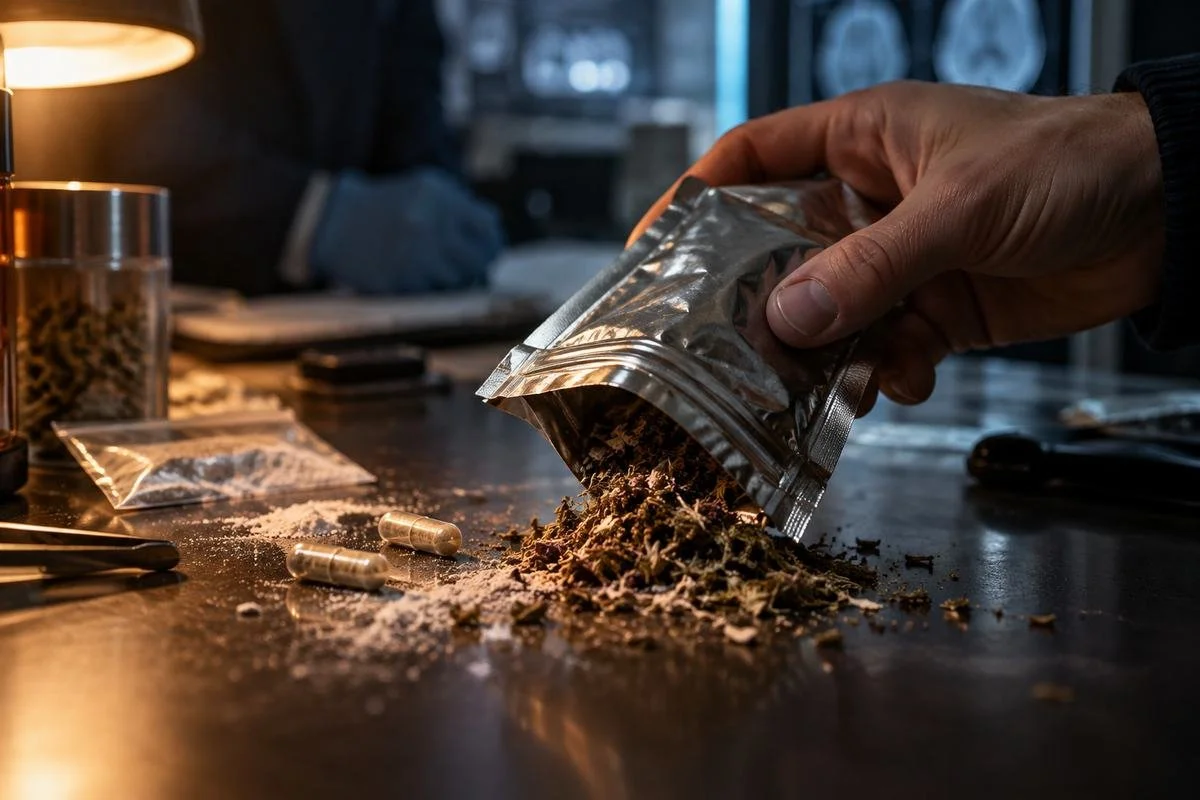
Perhaps one of the clearest examples occurred in 2018.
Hospitals began treating people who reported synthetic cannabinoid use but were developing unexplained and sometimes life-threatening bleeding.
Investigators eventually identified exposure to brodifacoum, a powerful long-acting anticoagulant commonly associated with rodenticides. Hundreds of cases were ultimately linked to the outbreak (CDC, 2018).
Why brodifacoum ended up in those products was never definitively established.
But by that point the public-health question had changed.
It was no longer simply:
“What does this drug do?”
It had become:
“Do we actually know what drug is in this product?”
That may be the most important lesson from K2 and Spice as we look at what is happening now.
Now Consider Kratom and 7-OH
Kratom itself is not a new substance.
Mitragyna speciosa has a long history of use in Southeast Asia. Its primary alkaloid, mitragynine, and the smaller naturally occurring amount of 7-hydroxymitragynine interact with opioid receptors.
But traditional kratom leaf should not automatically be treated as equivalent to today's concentrated 7-OH tablets, gummies, shots, or other enhanced products
For readers who want the background first, our detailed overview of kratom and 7-OH potency and usage differences explain traditional kratom, its major alkaloids, and how modern U.S. concentrated products differ from traditional use.
That distinction matters because 7-OH exists naturally in kratom in relatively small quantities, while modern commercial products can contain dramatically enhanced concentrations or can be manufactured by converting other kratom alkaloids into 7-OH.
For people who have already developed physical dependence on traditional or concentrated kratom products, Kratom addiction treatment may look different depending on the product used, dose, duration of use, withdrawal symptoms, and whether higher-potency derivatives are involved.
This is another reason simply asking someone, “Do you use kratom?” may no longer provide enough information.
MGM-15, MGM-16, and Mitragynine Pseudoindoxyl Show That Chemistry Is Already Changing
The evolution beyond concentrated 7-OH is no longer theoretical.
Mitragynine pseudoindoxyl, MGM-15, and MGM-16 are chemically related to mitragynine or 7-OH and act at the mu-opioid receptor.
DEA temporarily placed all three substances into Schedule I effective August 26, 2026 (DEA, 2026b).
The federal process involving concentrated 7-OH itself has followed a separate regulatory track involving a proposed threshold designed to distinguish targeted concentrated or manufactured products from naturally occurring trace levels in botanical kratom (DEA, 2026a; U.S. Department of Health and Human Services [HHS], 2026).
Because these regulations are evolving, readers should review Recover Clarity's regularly updated page on 7-OH, MGM-15, and kratom legal-status and product changes rather than relying on older social-media posts or outdated articles.
MGM-15 is particularly relevant to the K2 comparison.
It demonstrates that the market has already moved beyond simply concentrating naturally occurring 7-OH. For additional background, our earlier article examining MGM-15 as an emerging opioid threat discusses how these newer compounds began entering the commercial marketplace.
This does not prove that another wave of designer opioids will inevitably emerge after current scheduling actions.
But it does give public-health professionals a reason to watch carefully.
And Now There Is “Cat’s Claw”
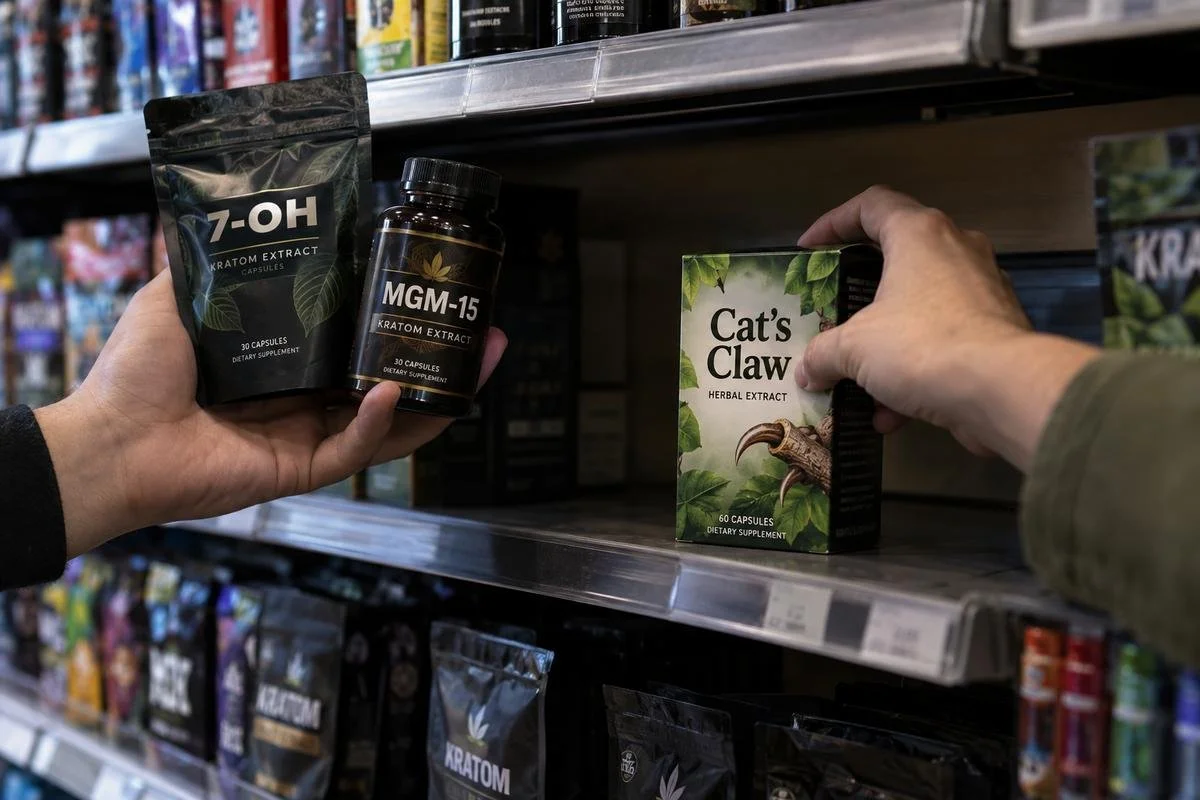
Another development makes awareness especially important.
Cat's Claw is a real botanical name commonly associated with plants from the Uncaria genus. Traditional botanical Cat's Claw should not automatically be confused with 7-OH, MGM-15, or other kratom-derived substances.
However, the name has recently appeared on products in a very different context.
In July 2026, the Utah Poison Control Center warned about products sold as Cat's Claw or kava blends following reports of serious opioid-like effects. The poison center warned that some products could contain undeclared kratom-related compounds (Utah Poison Control Center, 2026).
In September 2026, the Virginia Department of Health similarly warned that some products marketed as “Cat's Claw” had been found to contain unlabeled kratom alkaloids or synthetic kratom-related substances, including 7-OH (Virginia Department of Health, 2026).
This does not mean ordinary Cat's Claw botanical supplements are the same thing as these products.
It means product names and labels deserve scrutiny.
That subject deserves its own discussion and Recover Clarity will examine Cat's Claw products and their emerging role in greater detail separately.
We Should Not Assume 7-OH Will Become the Next Spice
The comparison to K2 has limits.
Synthetic cannabinoids interact primarily with cannabinoid receptors. 7-OH and the compounds related to it act primarily through opioid pathways.
Federal analogue laws are also more developed than they were during the early K2 era, and regulators now have substantially more experience identifying novel psychoactive substances.
There is also no guarantee that people currently taking 7-OH will switch to new designer substances when availability changes.
Some may simply stop.
Some may return to traditional kratom.
Some may seek professional treatment.
Others unfortunately may move toward different opioids or unknown substitute products.
We do not yet know which pathways will become most common.
That uncertainty is why education is important.
Treatment Needs May Also Change as the Market Changes
The retail environment surrounding 7-OH has created some unusual treatment challenges.
Many people did not originally think of themselves as using an opioid. They may have purchased a product from a smoke shop, convenience store, or online retailer and believed it was simply a stronger form of an herbal product.
When physical dependence develops, that realization can produce confusion, fear, and shame in addition to withdrawal itself.
Those differences are discussed more fully in How 7-OH Treatment Is Unique, which explores some of the clinical and psychological differences between 7-OH dependence and more traditional opioid-use pathways.
Readers looking more broadly at dependence, withdrawal, side effects, and safety concerns can also review Is Kratom Really Safe?.
The goal is not to label everyone who uses kratom or 7-OH as having a substance use disorder. Many people will not meet criteria for one.
The goal is to recognize when occasional use has become tolerance, escalating use, withdrawal, unsuccessful attempts to stop, or a return to other opioids.
Recover Clarity's Addictions We Treat page provides additional information about the substance-use concerns addressed within our treatment program.
What Should Consumers and Families Watch For?
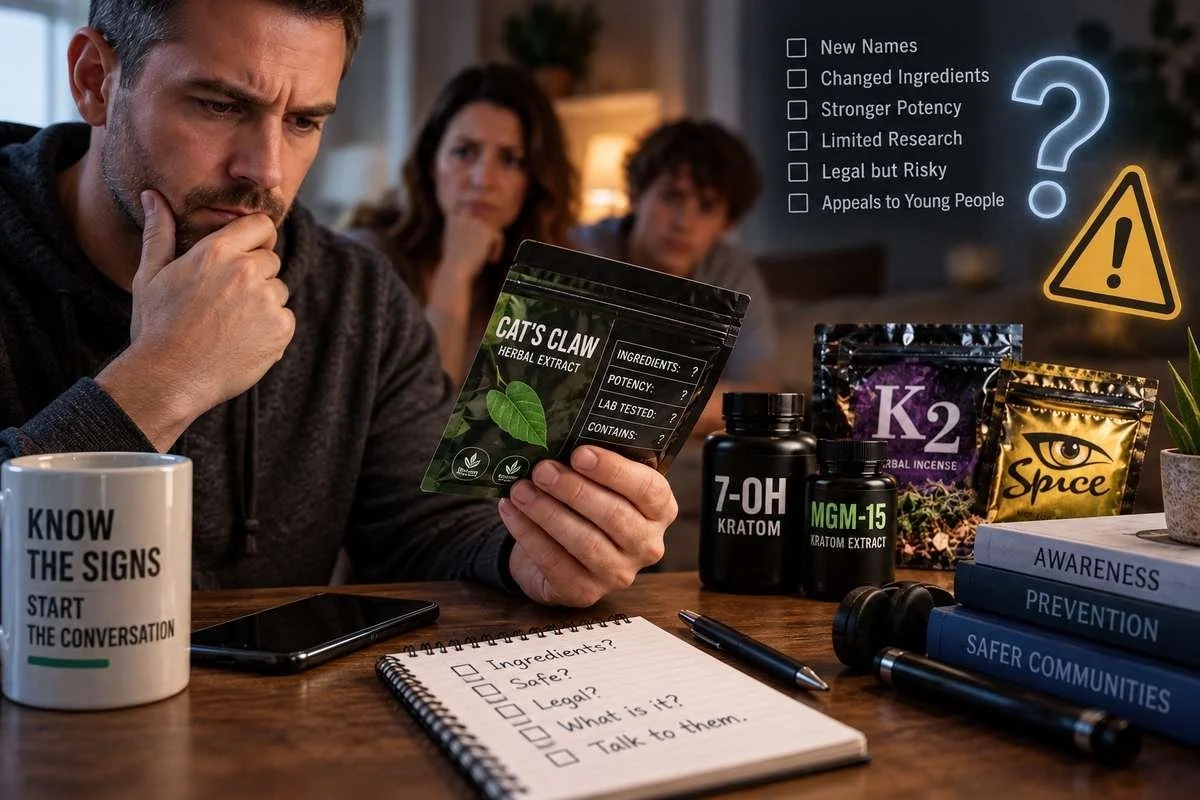
The goal should not be panicked. It should be awareness.
Watch for abrupt changes in product names, packaging, active ingredients, concentrations, appearance, or effects.
Be particularly cautious when a product claims to be “natural,” “herbal,” or “kratom-free” but does not clearly identify the pharmacologically active ingredients.
If someone tells a clinician, “I use kratom,” more questions may now be necessary. What exact product? Tablet, gummy, powder, liquid, or extract? What does the label say? Where was it purchased? Does it mention 7-OH, mitragynine pseudoindoxyl, MGM compounds, or enhanced alkaloids?
A photograph of the package can sometimes provide information that the general product name does not.
And if someone taking one of these products becomes extremely sedated, cannot be awakened, or develops slow or absent breathing, treat the situation as a potential overdose. Call 911 and administer naloxone if it is available and opioid exposure is possible.
Learn From History Rather Than Fear It
The history of K2 and Spice should not be distorted into an anti-regulation argument.
Synthetic-cannabinoid use among American high-school seniors declined dramatically from its early peak (University of Michigan, 2020).
That matters.
But history also demonstrates that reducing prevalence does not automatically eliminate an illicit marketplace or make the products remaining within it predictable.
The more accurate historical sequence was:
A legal-high market developed. Regulators responded. Overall use eventually fell considerably. Meanwhile, manufacturers continued introducing new compounds, product ingredients became increasingly difficult to predict, and severe outbreaks occurred years after the first chemicals had been scheduled.
That is the history worth remembering as MGM-15, MGM-16, and mitragynine pseudoindoxyl enter Schedule I and concentrated 7-OH faces additional federal regulation.
Nobody knows exactly what this marketplace will look like six months, one year, or several years from now.
Hopefully regulation reduces the number of people developing dependence on these substances.
Hopefully fewer people unknowingly begin taking powerful opioid-active products because they are available at a neighborhood retailer.
But history tells us to watch something else too:
What comes next?
Consumers should watch the new names.
Clinicians should watch changing products and symptoms.
Public health organizations should watch poison-center and toxicology data.
And individuals who are already physically dependent should understand that changing legal status does not mean they need to face withdrawal alone or simply replace one unfamiliar substance with another.
For Pennsylvania residents who are experiencing dependence on 7-OH, kratom concentrates, or other opioid-active substances, information about Pennsylvania addiction and Suboxone treatment is available through Recover Clarity.
The safest response to a changing drug market is not fear.
It is education.
Learn what you are taking. Ask questions. Keep up with changing laws. Talk openly with healthcare professionals. And remember that “legal,” “natural,” “herbal,” and “sold in a store” have never meant the same thing as “safe.”
K2 and Spice gave us a chance to learn that lesson once.
As the 7-OH market changes, we should use what history has already taught us.
Related Reading from Recover Clarity
7-OH Addiction Treatment
7-OH, MGM-15, and Kratom Law Changes
MGM-15: New Potential Opioid Threat
Kratom Part 1: What It Is and How It Works
Kratom Part 2: Is Kratom Really Safe?
How 7-OH Treatment Is Unique
References
Centers for Disease Control and Prevention. (2015). Notes from the field: Increase in reported adverse health effects related to synthetic cannabinoid use—United States, January–May 2015. Morbidity and Mortality Weekly Report, 64(22).
Centers for Disease Control and Prevention. (2018). Outbreak of life-threatening coagulopathy associated with synthetic cannabinoid use.
Gunderson, E. W., Haughey, H. M., Ait-Daoud, N., Joshi, A. S., & Hart, C. L. (2012). “Spice” and “K2” herbal highs: A case series and systematic review of the clinical effects and biopsychosocial implications of synthetic cannabinoid use in humans. The American Journal on Addictions, 21(4), 320–326.
Substance Abuse and Mental Health Services Administration. (2014). Update: Drug-related emergency department visits involving synthetic cannabinoids.
U.S. Department of Health and Human Services. (2026). Temporary placement of 7-hydroxymitragynine above a specified threshold in Schedule I: Request for information.
U.S. Drug Enforcement Administration. (2011, March 1). Chemicals used in “Spice” and “K2” type products now under federal control and regulation.
U.S. Drug Enforcement Administration. (2026a). Schedules of controlled substances: Temporary placement of 7-hydroxymitragynine above a specified threshold in Schedule I.
U.S. Drug Enforcement Administration. (2026b, August 26). Schedules of controlled substances: Temporary placement of mitragynine pseudoindoxyl, MGM-15, and MGM-16 in Schedule I.
University of Michigan, Institute for Social Research. (2020). Monitoring the Future: Synthetic marijuana—Trends in annual prevalence among secondary school students.
Utah Poison Control Center. (2026, July). Adulterated Cat's Claw and kava products may cause opioid overdose. University of Utah Health.
Virginia Department of Health. (2026, September 17). “Cat's Claw” products containing unlabeled kratom alkaloids.
Worob, A., & Wenthur, C. (2020). DARK classics in chemical neuroscience: Synthetic cannabinoids (Spice/K2). ACS Chemical Neuroscience, 11(23), 3881–3892.